El Hueco Medellín: A Local Mom’s Complete Guide
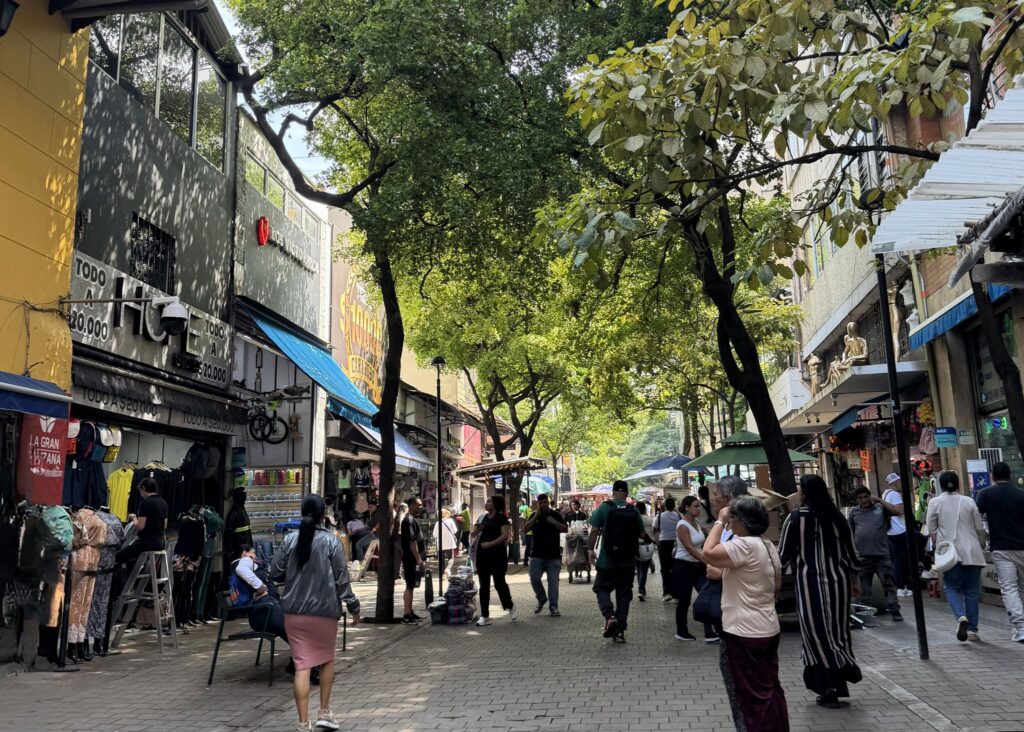
Two things are guaranteed in El Hueco Medellín: you can almost find anything there and go with a plan or you will get lost. I’ve been shopping here for a couple of years now. School supplies in July, kids soccer kits, last-minute birthday gifts, christmas gifts & stocking stuffers. And there are so many passageways I’ve never walked.
This is not a mall. This is a living, breathing commerce in the heart of downtown Medellín, built by families from the pueblos of Antioquia, one storefront at a time. If you’re new to the city, planning a visit, or one of the families navigating Colombia who keeps hearing the name and not understanding what it actually is, this guide is for you.
I recently did a guided tour with a wonderful local guide named Valeria, and it cracked the place wide open for me in a way years of solo trips hadn’t. I’ll get to her in a minute. First, here’s what you’re walking into.
- What Is El Hueco Medellín?
- A Quick History: Why El Hueco Exists Where It Exists
- La Candelaria: The Bigger Picture
- Carabobo: The Front Door
- Understanding the Locales (Store Numbers)
- Practical Tips for Shopping El Hueco (From a Mom Who Does This Regularly)
- My Tour With Valeria & ValenTours
- Visiting El Hueco FAQ
What Is El Hueco Medellín?
El Hueco is Medellín’s largest commercial district. The numbers, when you say them out loud, sound made up:
- More than 5,000 shops
- 84 interconnected commercial centers (centros comerciales)
- 66 passageways stitching them together
- Estimated 1 million visitors per day
- More than 17,000 direct workers (and that’s before you count the street vendors, the porters, the kids running deliveries on bicycles)
It covers roughly 23 city blocks in the Guayaquil sector, loosely bounded by Avenida Colombia, Avenida San Juan, Carrera Bolívar, and Avenida del Ferrocarril. People talk about “going to El Hueco” the way New Yorkers say “going downtown.” Iit’s a whole world, not a single address.
Not a Mall. It’s A Maze
If you walk in expecting a Colombian version of a North American shopping mall, you will be confused within ten seconds. El Hueco is the opposite of curated. Storefronts open into other storefronts. A jewelry shop bleeds into a perfume shop bleeds into a passage of school uniforms bleeds into a corridor of nothing but housewares kits. There are no maps. There are no directories. The signage is mostly for the people who already know where they’re going.
That’s the point. That’s the charm.
Why It's Called "The Hole"
El hueco literally means “the hole.” Locals will tell you the name comes from a few places — some of the original storefronts sat below street level, and the area used to feel like you were dropping down into a different city. But the more honest explanation is about the experience.
You fall in. And you don’t come out.
You know the Target effect? You walk in for detergent and walk out with a cart full of things you didn’t know you needed and can’t explain. El Hueco invented that. Except here it’s a soccer kit, two pairs of leggings, a set of plastic containers, and a bag of empanadas you already finished while browsing more things you didn’t need.
The hole pulls you in. That’s just what it does.
The name stuck so hard that in 2001, the administrators of centros comerciales El Hueco Pichincha, El Hueco Número Uno, and Centro Comercial Japón officially registered “El Hueco” as a brand. The hole had a trademark before most malls in this city had a food court.
A Quick History: Why El Hueco Exists Where It Exists
This corner of Medellín has been a commercial sector since before 1889. That’s not a typo. Commerce has been happening here for over 135 years.
The Train Station That Built a District
The anchor was the Estación del Ferrocarril, the old Medellín train station of the Ferrocarril de Antioquia, where the first passenger train arrived on March 9, 1914. Before the railway, the area around the Guayaquil market square and Plaza de Cisneros was already where the country roads converged, where farmers brought goods, where merchants slept in cheap hotels with their wares
When the train arrived, Guayaquil became Antioquia’s “puerto seco,” the dry port. Cattle, coffee, corn, panela, textiles, raw materials for the city’s growing industry. All of it came through here. Hotels turned into warehouses. Hotel rooms turned into storefronts. The neighborhood was arguably Medellín’s first real commercial district, long before the modern malls of El Poblado existed.
The Pueblo Migration of the Late 1990s
The El Hueco we know today started taking shape around 1997, when merchants from the eastern Antioquia pueblos El Santuario, Granada, and Marinilla began arriving in Guayaquil. They opened small shops selling clothing and household goods. Because most of them were related. Siblings, cousins, in-laws, they started knocking down walls and connecting their stores so they could move between them without going outside.
One passage at a time. One family at a time.
That’s how the labyrinth we see today was built. It wasn’t designed. It was grown.
La Candelaria: The Bigger Picture
El Hueco sits inside La Candelaria, Comuna 10, Medellín’s historic and foundational center. La Candelaria is the heart that everything else grew out of: the cathedrals, Parque Berrío, Plaza Botero, the Palacio de la Cultura, the old train station, San Antonio Park. Comuna 10 is where Medellín began.
Quick note if you’re coming from Bogotá or have spent time there: yes, there’s a La Candelaria there too. It’s not a coincidence. The name comes from the Iglesia Nuestra Señora de la Candelaria, and Colombian cities historically built their identity around the church at their center. So, the pattern repeats. In Bogotá, La Candelaria grew up around the church built at the end of the 17th century, and the same logic applies in Medellín. Same name, same idea, completely different energy. Bogotá’s La Candelaria is cobblestone streets and colonial architecture. Medellín’s is vendors calling out prices and carts stacked with goods.
When people say they’re going to “el centro,” they usually mean somewhere in La Candelaria. El Hueco is the working, sweating, bargaining commercial engine of that historic core. You can spend a whole morning in El Hueco and a whole afternoon walking Plaza Botero and the cathedrals without ever leaving Comuna 10.
Carabobo: The Front Door
Carrera Carabobo (Carrera 52) is one of the most trafficked pedestrian streets in all of downtown Medellín. The pedestrianized stretch runs from around Parque de las Luces up toward Plaza Botero, lined with shoe shops, snack bars, and street vendors with megaphones shouting prices.
For most visitors, Carabobo is the front door into El Hueco. You hop off the metro at San Antonio, walk west, and the energy thickens around you the closer you get. By the time you cross into the alleys off Calle 46 or Calle 48, you’re in.
Understanding the Locales (Store Numbers)
Here’s a small but important thing to understand before you go in: every shop has a local number painted on a little plaque. Something like Local 121A, Local 366, Local 602. When a vendor or a regular tells you where to find something, they don’t say “the shop with the pink awning next to the empanada lady.” (Well, they might. But that won’t actually help you.) Their actual address looks something like this:
“Centro Comercial Hueco Pichincha, local 121A.”
That’s it. That’s the whole address inside the maze. The centro comercial name plus the local number. Once you start reading them, the chaos has a system. Vendors find each other this way. Regulars text each other this way. If a friend recommends a specific shop, ask for the local before you go. It’s the only thing that will help you find it again.
Practical Tips for Shopping El Hueco (From a Mom Who Does This Regularly)
Things you’ll be glad to know from day one.
Bring Cash. Really.
Most shops accept cash only. Some take card or you can pay transferencia or Nequi/Daviplata, but assume cash. Bring a mix of bills. You’ll get better prices when you can pay exactly.
Todo está. You Can Find Anything.
Anything you need is here. School supplies, uniforms, soccer cleats, the whole Selección Colombia kit, baby clothes, fabric, piñatas, birthday gifts, kitchen supplies, perfume, jewelry, suitcases, leather, holiday decor, costumes, beauty products stacked literally floor to ceiling. If you can name it, El Hueco sells it. Usually three doors apart, at three different prices.
Touch Before You Buy. Watch for Segundas.
Quality varies wildly. Some shops carry brand-new, well-made products. Others sell segundas or seconds, factory rejects, items with minor flaws. Both have a place, but you need to know which you’re holding. Check the seams. Check the zippers. Try the soccer cleats on the kid. Smell the perfume. Read the tags. The people who shop here every week do this without thinking.
Everything Is Negotiable. But Your Accent Matters.
Most prices here are not fixed. They are starting points. If you ask “¿cuánto vale?” and the vendor hears a foreign accent, the price quietly goes up. That’s not malice, it’s commerce. They’ve done it to countless extranjeros who didn’t bat an eye. The fix is simple: know what you want, know roughly what it should cost, and be ready to counter-offer or walk away. Walking away is your most powerful tool. More than once I’ve taken three steps and heard a vendor call out a much better number.
Timing Is Everything
- Best time to go: weekday mornings, between 9 and 11 a.m. Stores are open, crowds are thinner, vendors are friendlier.
- Avoid quincena. In Colombia, payday lands on the 15th and the 30th of the month. Around those dates, downtown floods with shoppers. It’s pura locura.
- Know that December is slammed. From late November through Christmas, El Hueco becomes the busiest commercial zone in the country. People come in from all over Antioquia. Beautiful chaos, but not the day to introduce a five-year-old to crowd navigation.
- Stop by 5 p.m. Most shops close by 7 p.m. and the area empties fast. Sundays, almost everything is closed.
Dress Down. Backpack in Front. No Jewelry.
This is the same advice I’d give for any busy commercial district anywhere in the world. Wear something casual. Keep flashy jewelry at home. Backpack on your front in crowded passageways. Phone in your bag, not your hand. A simple crossbody works great. The goal is to look like someone who lives here, because the people who live here aren’t getting robbed. They just blend in and move with intention.
Bringing the Kids
You’ll see kids in El Hueco — strollers, school-age kids in tow, the whole thing. It’s a family place. But let me be real with you: I don’t even love shopping with my kids at a regular mall, so I usually leave them at home and give myself the freedom to browse and take my time.
That said, I’ve brought my oldest before to shop for school supplies and it was completely fine — because I knew exactly where we were going and what we needed. That’s really the key. When you have a plan, know the timing, and feel comfortable in the space, kids are totally manageable here. Like anywhere.
But if it’s your first time and you actually want to enjoy the experience? Leave them home. Reconnaisance mission first. Kids later.
Know Your Prices
Before you go, look up what something costs at a regular mall (Mayorca, Premium Plaza, Santafé). Now you have a ceiling. El Hueco prices should sit comfortably below that. If a vendor quotes you the same price as a mall, you’re getting tourist-taxed. Smile, say gracias, walk to the next stall. There are usually five more selling the exact same item within fifty meters.
Safety: Common Sense, Not Fear
I want to be real clear about this part because the internet loves to scare people. It’s not curated for tourists. It’s a real working commercial district with a working-class clientele, families pushing strollers, abuelas with shopping carts, dads buying their kids cleats. It is not a place where you should be afraid. It is a place where you need to pay attention.
Pickpocketing happens, especially around quincena and December. The vast majority of visitors have zero issues. The “no dar papaya” rule (don’t make yourself an easy target) covers it: stay aware, keep valuables out of sight, stick to streets with foot traffic, leave before dark.
A Quick Note on Language
This isn’t a tourist zone. it’s a working market for working Colombians, and Spanish is the language of the place.
That’s not a barrier. That’s a sign of respect to the place.
If your Spanish is shaky, that is genuinely fine. Try anyway. Vendors are patient. Numbers are universal, calculators come out, smiles get you very far. What doesn’t fly is showing up with the energy of someone who expects English, sighing when nobody speaks it, and treating Spanish like a problem instead of the actual language of where you live or are visiting.
Learning to navigate El Hueco in Spanish, even badly, is one of the most respectful things you can do here. There is no place for entitlement in a maze built by people from the pueblos.
My Tour With Valeria & ValenTours
I want to talk about Valeria for a minute, because she changed how I see this place.
She’s starting to run monthly themed tours of El Hueco. I went on the first and it was a Mother’s Day theme focused on beauty products, t-shirts, perfumes. She offers custom tours when you have a specific shopping list.
I lucked out! My tour ended up turning into a hybrid since it was just me: I was down for the ride but also let her know I was looking for new Selección Colombia kits for my kids, a couple of birthday gifts, and made the most of refilling my beauty cabinet without the markup.
Walking through El Hueco with Valeria was like going to a party where you finally know someone who knows everyone. She knew every entrance. Every shortcut. Which passageway connects Hueco Pichincha to Megacentro without going back outside. Which beauty shop stacks product floor to ceiling with the fastest turnover, which means freshest inventory.
She and her sister also did the thing I cannot do, which is negotiate across vendors at a paisa-level. They asked three shops the price of the same item in three minutes flat, and we’d circle back to the best one with the right answer in hand. I saved real money. More importantly, I now actually know where to go when I need things, instead of wandering into the maze and hoping.
If you’re new to Medellín or new to El Hueco, take a tour with ValenTours at least once. It’s not about needing a babysitter, it’s about getting handed a key to a city you live in. Check out her Instagram to find out more information on her next tour or reach out to her directly on WhatsApp at +57 300 2600379.
Visiting El Hueco Medellín FAQ
Location: Guayaquil sector, La Candelaria (Comuna 10), downtown Medellín. Roughly bounded by Avenida Colombia, Avenida San Juan, Carrera Bolívar, and Avenida del Ferrocarril.
Hours: Monday to Saturday, approx 9 am – 7 pm Most shops closed Sunday. Some passages and centros comerciales open slightly later or close slightly earlier (lol) I’d recommend going in the mornings.
How to get there: Take the Medellín Metro to San Antonio station (Line A), then walk west. The Tranvía also stops at San Antonio. From the metro exit, you’re in El Hueco within five minutes of walking. Cisneros station (Line B) also drops you on the western edge.
Cost: Free to enter. No tickets, no admission, no entry fees for any of the centros comerciales. You only pay for what you buy.
Pro tip: Go on a weekday between 9 and 11 a.m., bring cash in mixed bills, wear a small backpack on your front, and have a list. If it’s your first time, book a guided tour with Valentours and let someone who knows the maze do the navigating while you focus on the shopping.
My Tour With Valeria & ValenTours
It would be easy to write El Hueco off as “the cheap shopping place.” A lot of guides do. But the longer I live in Medellín, the more I see this district as something else entirely.
This is generational commerce. The shop you buy from today was likely opened by someone’s parents or grandparents who came down from a pueblo in the 90s with a dream and a few rolls of fabric. The kid running the register at lunch is probably the owner’s daughter, doing her homework between customers. The passageway you walk through was knocked through a wall by two brothers who wanted to share customers.
When you spend money in El Hueco, you’re not feeding a logo. You’re feeding a family that built this thing brick by brick, family by family, passage by passage, for almost three decades. That’s worth supporting on purpose.
It’s also where I do my real shopping as a mom living here. School supplies in January? El Hueco. Bici cross gear for my son? El Hueco. White boots for my daughter’s K-Pop Demon Hunters costume? El Hueco. The piñata, the party favors, and the gift bags for whichever kid is turning whichever age this month, and there’s always one, El Hueco. The everyday stuff that makes a family run. You figure that out pretty quickly when you live here.
It’s not a museum. It’s not a “must-see attraction.” It’s a place where the city actually works.
If this guide helped you feel less intimidated about El Hueco, save it, screenshot it, send it to the friend who’s moving to Medellín next month and excited about exploring about the city center.
For more guides like this from someone living, parenting, and figuring it out in Medellín alongside you, follow along on Instagram at @mamainmedellin. I share the small stuff there too: the playgrounds, where to find extracurriculars for your kids, the days that go sideways and the days that don’t.

MEET SARAH
Welcome! I’m Sarah. I started this blog to be a resource for others around a few of my favorite things: living in Colombia, DIY projects, places traveled, and day-to-day life. My hope is that it can a place of inspiration and encouragement to help you plan the next project or adventure of your own!