Colombian Birth Registration: Your Step-by-Step Guide
- Registro Civil de Nacimiento
- How to Apply for Your Baby’s Colombian Passport in Medellín
- Step 1: Pay deposit
- Step 2: Schedule appointment
- Documents You Need for the Colombian Passport Application
- Tips for Your Baby’s Passport Photo in Colombia
- Passport Pickup: Timeline and What to Expect
- Does Colombia Offer Birthright Citizenship?
- What Comes After the Registro Civil: Next Steps for Families
- Frequently Asked Questions About Birth Registration in Colombia
Registro Civil de Nacimiento
What You Need to Know Before Registering a Birth in Colombia
Before you head to the notaría or registraduría, here’s a quick overview of how birth registration works in Colombia so you know what you’re walking into.
In Colombia, your baby’s birth is registered through the Registraduría Nacional del Estado Civil. The process creates their registro civil de nacimiento (birth certificate), which is the foundational legal document for everything like their passport, health insurance enrollment, and, if applicable, citizenship registration in your home country.
The registration itself is free. You’ll pay only for notarized copies, which you’ll want multiple of (more on that below). The process is different depending on whether at least one parent is Colombian or if both parents are on visas and is broken down below.
Where to Register: Notaría vs. Registraduría in Colombia
You have two options to get your child’s registro civil de nacimiento:
- Before leaving the hospital: If at least one parent is a Colombian Citizen, a notary can help file and submit the registration (except on Sundays).
- At a notaría or registaduría of your choice: Within a month of the child’s birth; otherwise, certain documentation will expire.
Be aware that the notary representative at the hospital may be from a notaría far from where you live. Notarías in Colombia don’t share information – not even with the notaría primera in Bogotá.* The notaría where you submit the registration is the only place where you can handle any related paperwork for your child’s birth certificate. It’s important to ask the notary representative which notaría they are from so you don’t end up stuck with an office on the other side of the city.
When I asked the notary representative where parents should go if neither of them are citizens but are instead in Colombia on visas, she recommended the Registaduría as opposed to a regular notary.
*However, if you receive any registro civil at a Colombian consulate, the notaría primera in Bogotá is the only notaría in Colombia you can get copies from.
I opted to do it at the notaría where we registered my son, which was different from the hospital notary representative’s home office.
If at Least One Parent Is a Colombian Citizen
If you or your partner holds Colombian citizenship (whether born in Colombia or acquired through a parent, like me), you can register at any notaría. You can start the process at the hospital if a notary representative visits, or schedule it at a notaría of your choosing within 30 days of birth.
This was my path. I registered both of my children born in Medellín at the same notaría I’d used before. Familiarity with the process and the staff made it much smoother the second time around!
If Both Parents Are Foreign Nationals on Visas
If neither parent is a Colombian citizen, you’ll register at a Registraduría Nacional del Estado Civil rather than a notaría. You can find a directory of offices on the Registraduría’s website.
Important: at least one parent must have legal domicile in Colombia (meaning a valid visa whether it’s work, student, marriage, or resident) at the time of the child’s birth for the child to be eligible for Colombian citizenship. A tourist stamp or entry permit alone is typically not sufficient. If you’re unsure whether your visa status qualifies, consult an immigration lawyer before the baby arrives.
Foreign documents (like your passport, marriage certificate, or birth certificate from your home country) must be apostilled and translated into Spanish by an official translator in order to be accepted.
Required Documents for Colombian Birth Registration
Here’s what you need to bring. I always recommend bringing extra documents just to be safe. Doing anything official in Colombia sometimes means you’ll be asked for something not listed on the website.
- Baby: Footprints are taken at the appointment
- Lab results: Showing blood type and Rh factor
- Certificado de nacido vivo
- Your cédula and a photo copy of the cédula
- Your partner, their cédula or passport, and a photo copy of their identity document
- Your registro civil de matrimonio
- A copy of your partner’s visa (not needed but brought just in case)
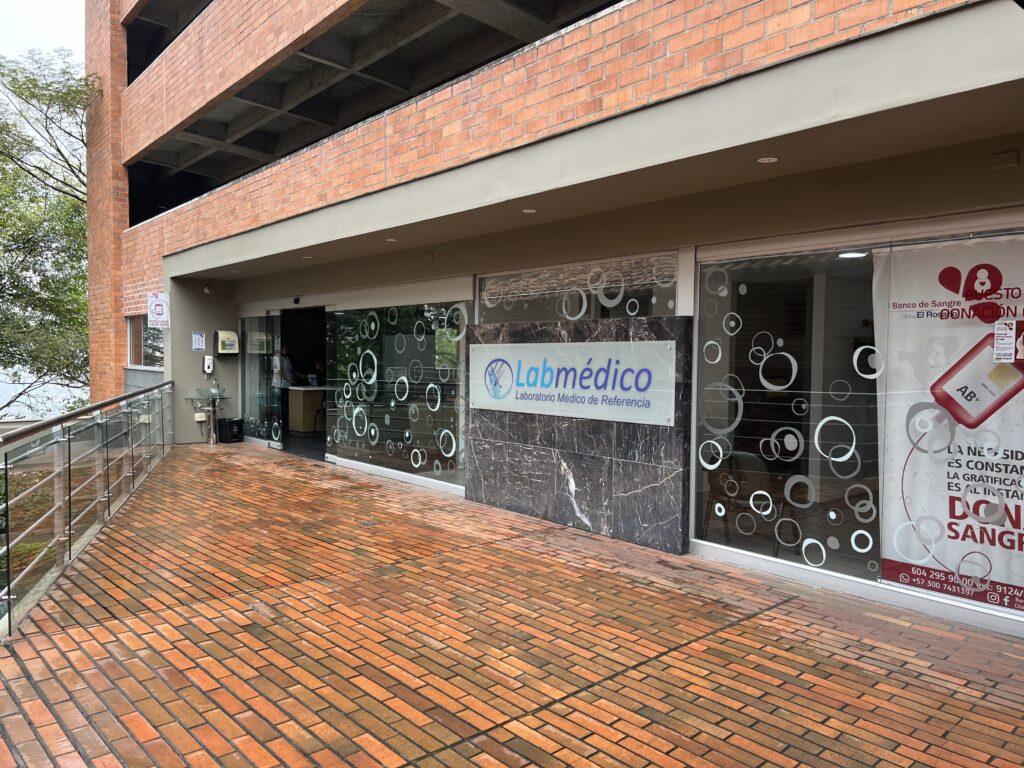
On the day my babies were born, my gynecologist gave me a “Certificado de nacido vivo.” The notary keeps the original, and the copy is for your records. Additionally, lab work showing the baby’s blood type and Rh factor is submitted. The first time, I picked up the results at Clinica El Rosario 2-3 days after I was discharged. The second time, I stopped at the laboratory (Labmédico) on our way out to provide my email address. It’s located on the left-hand side next to “Doggers” as you exit the hospital and approach the parking garage. I received the results via email the day after we were discharged.
Step-by-Step: The Registro Civil de Nacimiento Process
At the notary, there’s a dedicated desk for “registro civil.” You can’t make an appointment so it’s good to get there early when it is less likely that there is a line. We provided the agent with the documents listed above, and he asked for:
- Child’s full name
- Address
- Phone number
Biometrics, Baby Footprints, and Your Baby’s NUIP
While completing the information, the agent asked my partner to complete his biometrica (biometrics). This legal requirement guarantees the highest security in terms of identification for notarial procedures by comparing fingerprints against the National Registry of Civil Status database. (Source) Once this was complete, my partner signed the registro civil, and the agent took my baby’s footprints.
At this point, your baby is assigned their NUIP, the Número Único de Identificación Personal (Unique Personal Identification Number). You’ll find it on the top left-hand side of the registro civil. This number stays with your child for life and is required for their first pediatric appointment, EPS enrollment, passport application, and every future identity document in Colombia. Save a photo of the registro civil on your phone immediately! You’ll be asked for the NUIP all the time.
How Many Copies to Request (and What They Cost)
The agent then printed the four copies of the registro civil I requested, stamped, and dated each copy. These copies were for:
- Colombian passport application
- U.S. Consular Report of Birth Abroad (CRBA) & Passport application (two copies)
- To keep in my passport holder. Colombian migración agents and airlines often request the registro civil de nacimiento to prove parentage to mitigate child trafficking and ensure children’s safety, even when both parents are traveling with the child. I always carry physical copies for all three kids.
We paid 59,700 COP for the four copies and then walked over to the side of the room where the notary finally signed.
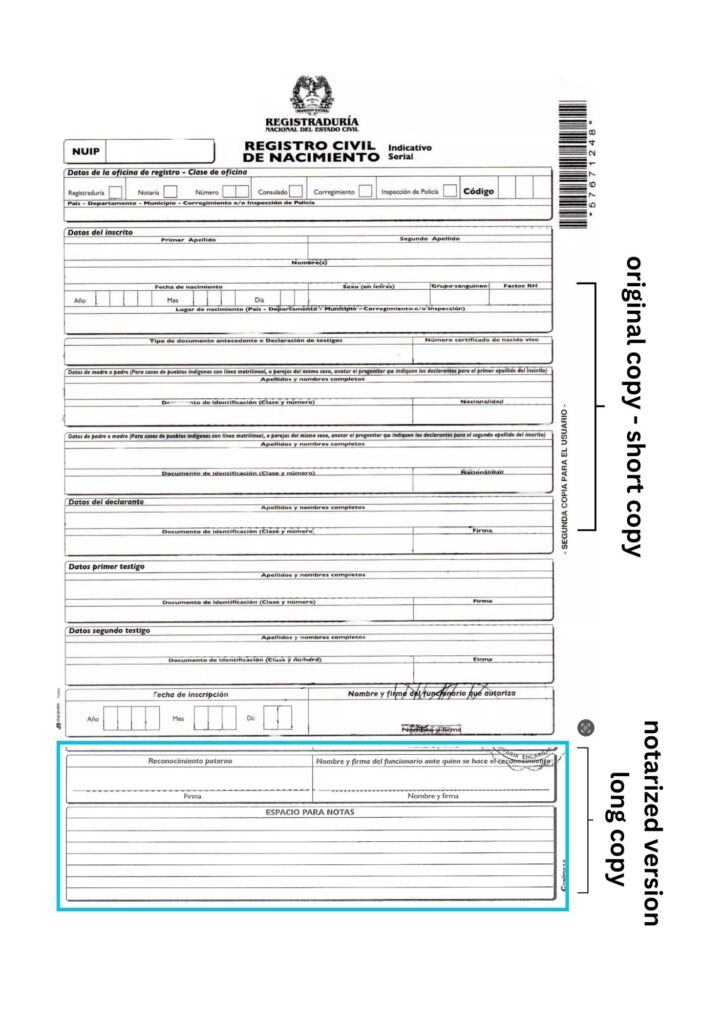
The notarized version is both the original copy plus the box highlighted in blue and sometimes referred to as the “long” copy.
When you leave the notaría, you’ll receive the original copy, or the top part of this document along with the notarized copies. Save it for your records.
I brought both the original and the long, notarized copy to my passport appointment.
Understanding the NUIP: Colombia’s Unique ID Number for Babies
The NUIP (Número Único de Identificación Personal) is Colombia’s equivalent of a Social Security number, except your child receives it at birth and carries it for life. It was introduced in 2004 to replace the older PIN system and ensure every Colombian citizen is identified by a single number from birth to death.
Your child’s NUIP will appear on every identity document they ever receive in Colombia:
- Registro civil de nacimiento (birth certificate) that’s assigned at registration
- Tarjeta de identidad: Required at age 7
- Cédula de ciudadanía: Issued at age 18
Like I mentioned earliery, you’ll need the NUIP almost immediately after registration: for your baby’s first pediatric appointment and thereafter, to enroll them in the EPS health system, for vaccine records, and for the Colombian passport application. It’s also the number migración and airline agents reference when verifying parentage at the airport.
Important Deadlines: Register Within 30 Days of Birth
Officially, you should register your baby’s birth as soon as possible. If at least one parent is a Colombian citizen, you can start the process before you even leave the hospital! A notary representative may visit to begin the paperwork. Except on Sundays.
The practical deadline is within one month of your baby’s birth. After 30 days, the certificado de nacido vivo (live birth certificate) issued by the hospital may expire, and you could be required to provide additional documentation like sworn witness statements or even a baptism certificate as proof of birth. (Read: Absolute headache. Get it done within 30 days)
For families on visas, timing matters even more. Your visa documentation needs to be current, and any foreign documents must be apostilled and translated into Spanish by an official translator. If your visa is close to expiring, factor in the time needed for birth registration, because the registro civil is required before you can apply for your baby’s passport or begin their citizenship process in your home country.
Additional time-sensitive items to keep in mind:
- Lab results: These also include the hormona estimulante de la tiroides (TSH) results, which test for thyroid problems. Your pediatrician will ask for these at your baby’s first visit, 2–3 days after discharge.
- Insurance: Once I had the registro civil, I forwarded it to my insurance agent to add my baby to our plan. Don’t delay this. Coverage gaps matter.
For more details, visit the Registraduría’s website.
How to Apply for Your Baby’s Colombian Passport in Medellín
There are four steps to getting your baby’s Colombian passport. I’ve done this twice now in Medellín and the process has been consistent both times.
Step 1: Pay deposit
Here’s the website to make the first payment.
You’ll need:
- Child’s NUIP
- Full Name
- Parent’s email address
- Cell phone number
- Select the type of passport
- Proceed and finalize payment
You can choose between an ordinary passport or executive passport (for high-volume travelers):
- Ordinary passport: 32 pages
- Total cost: 308.000 COP
- First payment – online: 172.000 COP
- Second payment – at passport office: 136.000 COP
- Valid for 10 years
- Executive passport: 48 pages (extra travel stamp space!)
- Total cost: 416.000 COP
- First payment – online: 172.000 COP
- Second payment – at passport office: 244.000 COP
- Valid for 10 years
Things to Note
- The portal opens weekdays at 8 am with approximately 1,300 appointments available for the next 2-3 business days and it books up fast. One morning, I had issues with Bancolombia, and by 8:07 am, all slots were taken. I had to try again the next day.
- You can pay using PSE or Efecty. I used Bancolombia via PSE, and the payment processed immediately.
- Remember the date of the first payment; you’ll need it to schedule your appointment.
- Print the confirmation of payment email and bring it with you to your appointment.
Step 2: Schedule appointment
Once your payment is accepted, use this website to schedule your appointment.
You’ll need:
- Your child’s NUIP
- Date of the first payment
- Type of passport requested
- Select the date and time
Things to Note
Be prepared with dates and times that work best for you within 2 days of applying. You don’t have time to consult your calendar during this step or you run the risk of losing appointments, being timed out, and having to try again the next day. You can’t book more than 2–3 days in advance. I was able to make my deposit and schedule our appointment on the same day (a Wednesday), with the appointment two days later on Friday.
Documents You Need for the Colombian Passport Application
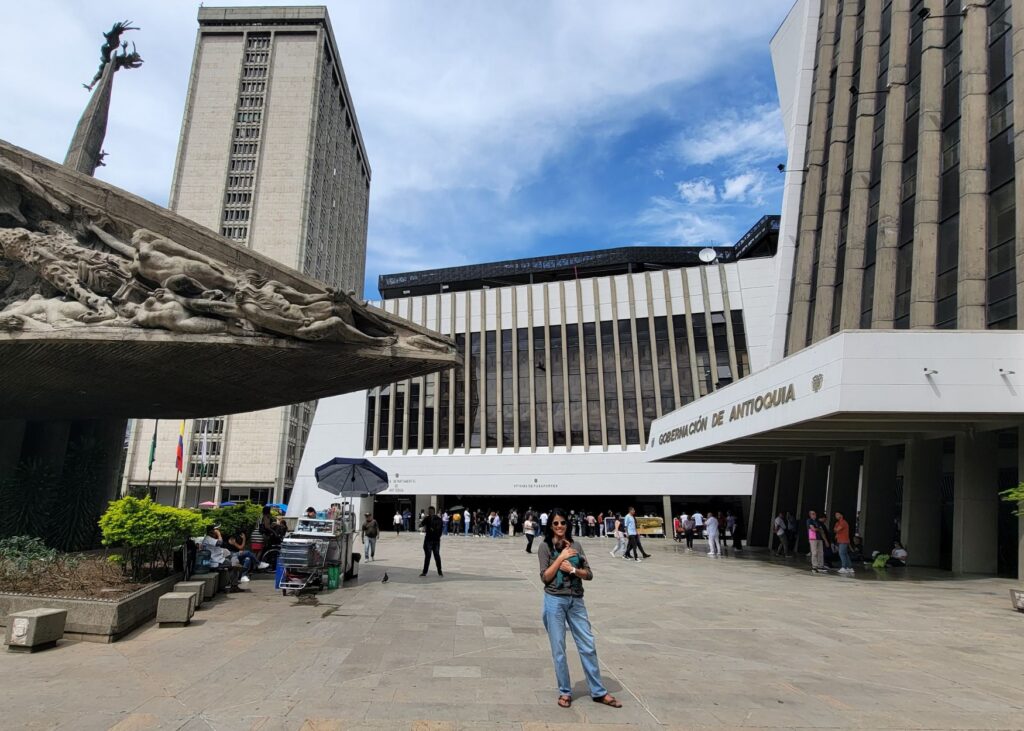
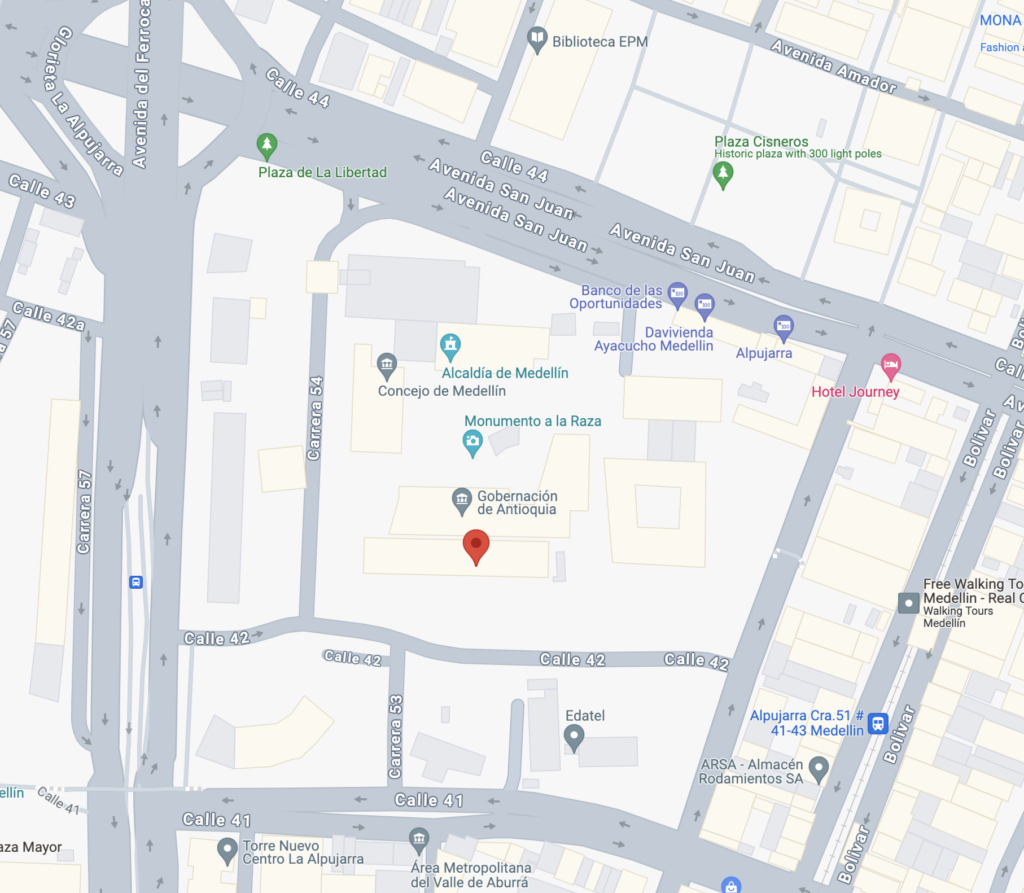
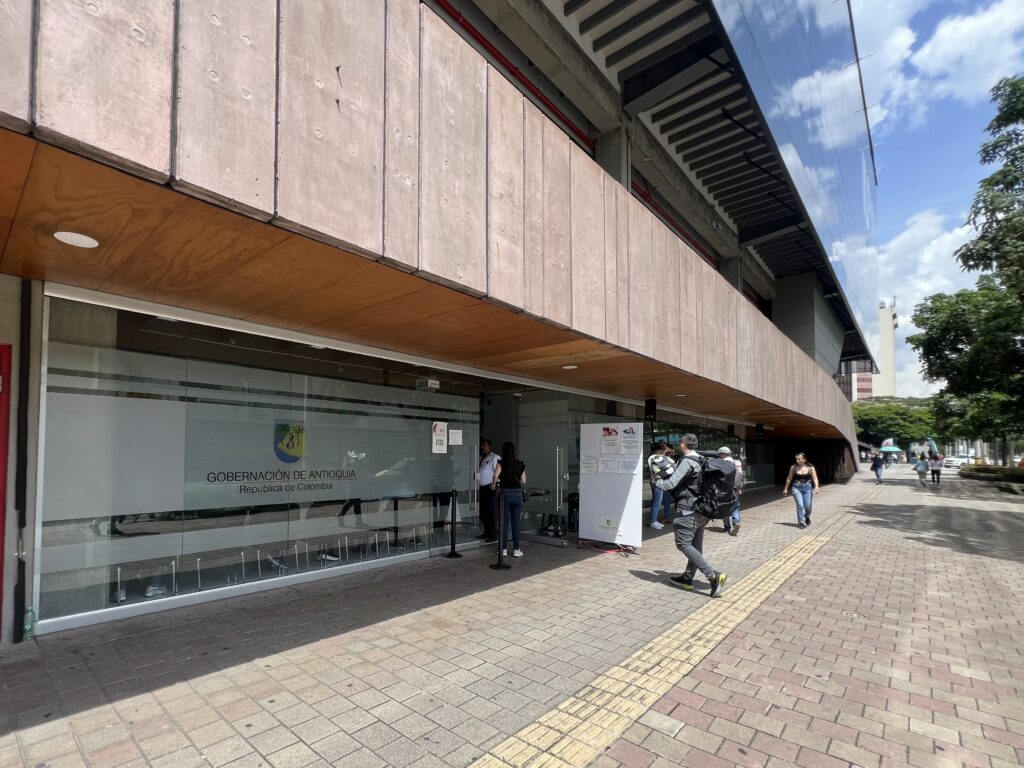
The passport office is located at Gobernación de Antioquia on the first floor, at Calle 42 #52-106. As the Colombian citizen, my partner didn’t have to come with me but he did just in case.
For required documents, the government website isn’t very clear. In the FAQ section of the Antioquian government website, it details what extranjeros (foreigners) need. I found more information for Colombian citizens on the Cancilleria’s website.
Based on my experience obtaining my son’s passport in Colombia, I knew what to bring. Also based on my experience of doing anything in Colombia and to avoid multiple trips, I brought extra documents just to be safe.
What I Definitely Needed:
- Baby: They take the baby’s picture at the appointment
- A soft, thick baby blanket: To cushion the baby when they take her photo (they provide a white sheet for the background)
- Baby’s registro civil de nacimiento: The legal paper size, notarized version
- Copy of my registro civil de nacimiento: Doesn’t have to be a recent copy
- My cédula and a copy
- A copy of my mother’s cédula: Since I got my citizenship through her
- Final payment in cash: Must be in cash. If you don’t have cash, the nearest Bancolombia cajero (ATM) can have long lines depending on the day and time.
What I Also Brought Just in Case
- Baby’s registro civil de nacimiento: The original, short version
- A copy of my partner’s cédula
- A copy of my partner’s visa
- A copy of our registro civil de matrimonio
- Electoral certificate: If you voted in the last election, you get a 10% discount on the second payment.
Tips for Your Baby’s Passport Photo in Colombia
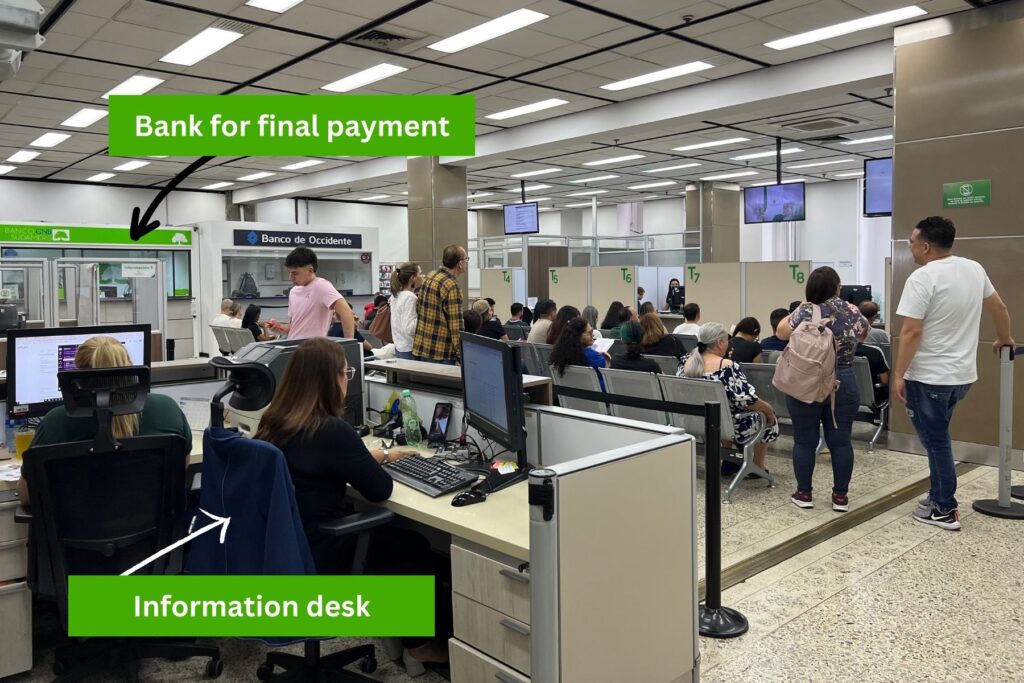
When you arrive, be sure to go to the “Fila Preferencial” (priority line) for the elderly, people needing special assistance, pregnant persons, and those with young children. Someone will check you in to verify your appointment and documentation. Then, you’ll head over to the information desk where they will begin processing your paperwork.
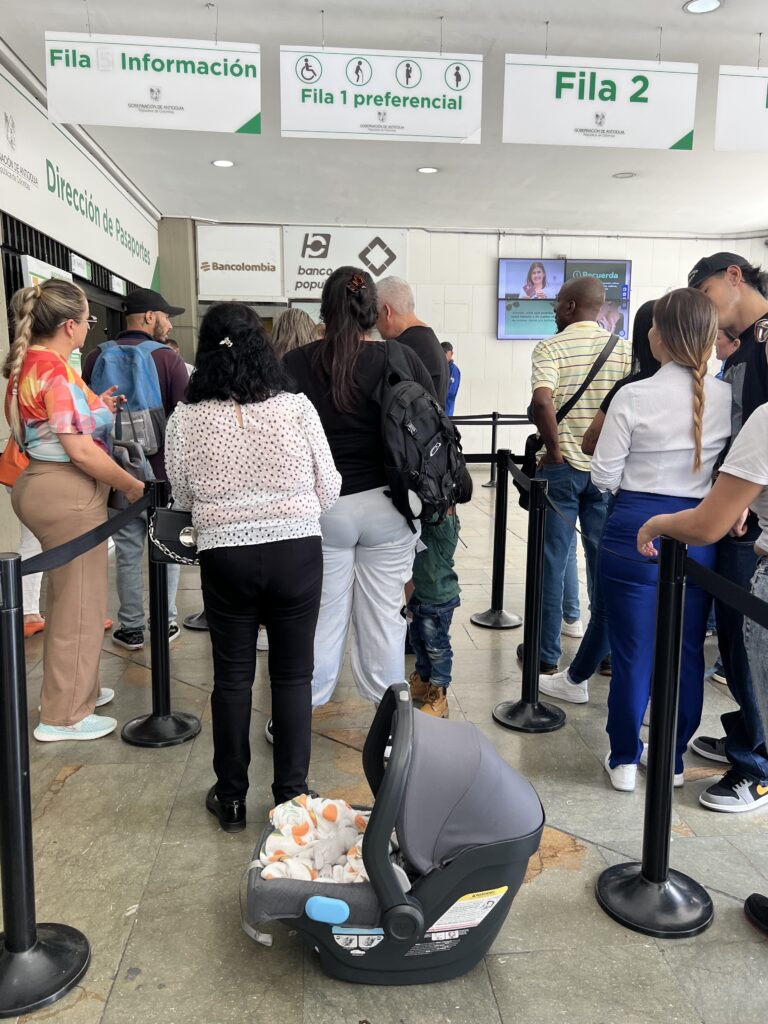
I provided all the documents, and the agent entered our daughter’s information for her passport. After a few minutes, we laid the baby blanket on the desk, the agent placed the white background sheet over it, and laid our daughter down for her photo. In Colombia, they want the baby’s eyes open, even if they are under 1 year old, so it helps to wake the baby up in advance.
Once you confirm the information entered, you sign, and proceed to make the final payment (in cash) in the same office near the main entrance. Hold onto the receipt to show proof of payment when you pick up the passport.
Passport Pickup: Timeline and What to Expect
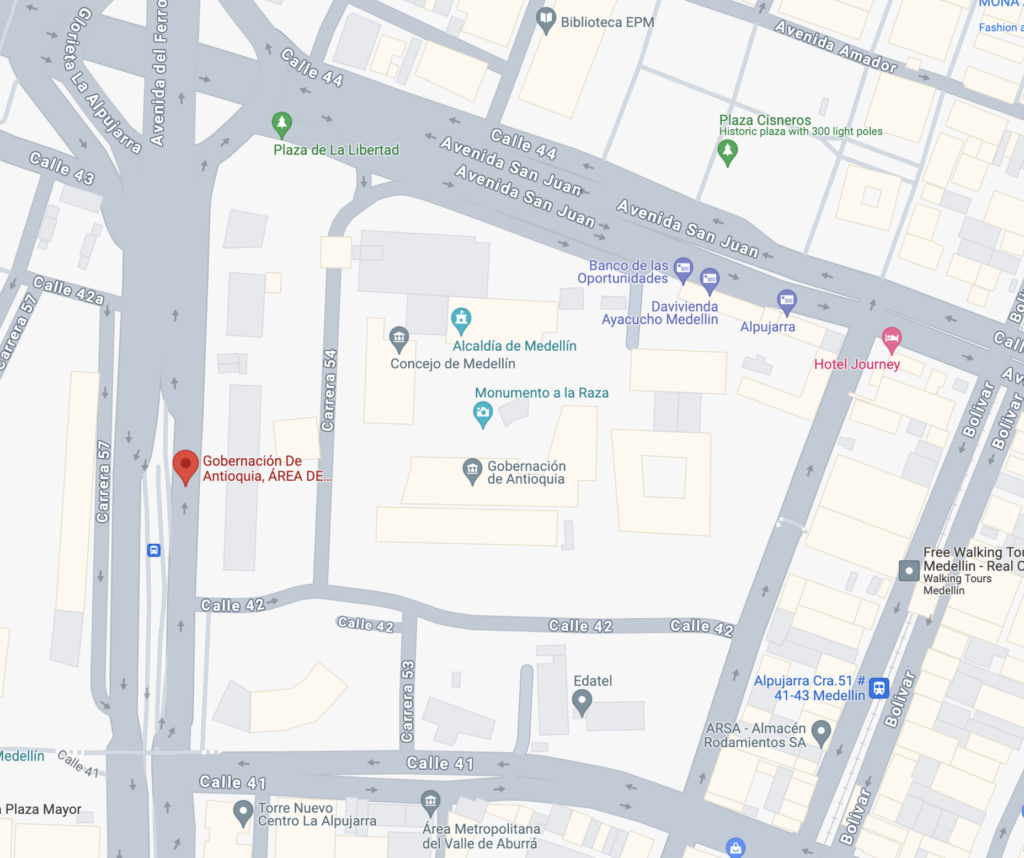
Last step! Both times I’ve applied, the passports were ready in a week. The passport pickup office is around the corner from where you apply. The address is Carrera 55 # 42-56 / Plaza de La Libertad / Local 4256. In my case, since I’m the Colombian citizen only I could pick up the passport.
Office hours are:
- Monday to Thursday: 7:00 a.m. to 5:00 p.m.
- Friday: 7:00 a.m. to 4:00 p.m.
- Saturday: 8:00 a.m. to 12:00 p.m.
What You Need:
Bring your baby (this allows you to skip the line), your receipt confirming final passport payment, and a notarized copy of the baby’s registro civil de nacimiento (can be physical or digital. They ask for the NUIP before going back to grab the passport).
I received an email two business days after our appointment informing me that my child’s passport was ready for pickup. When you arrive, there’ll usually be someone at the door confirming you have your receipt. If you bring baby, you get to skip the line and wait to be called by the next available agent. Simply show them your final payment receipt, they’ll ask you to confirm the NUIP, and then they’ll go back to get your passport. Review it to confirm all the information is correct, then you’re good to go!
I received an email two business days after our appointment informing me that my child’s passport was ready for pickup. When you arrive, there’ll usually be someone at the door confirming you have your receipt. If you bring baby, you get to skip the line and wait to be called by the next available agent. Simply show them your final payment receipt, they’ll ask you to confirm the NUIP, and then they’ll go back to get your passport. Review it to confirm all the information is correct, then you’re good to go!
Registro Civil de Nacimiento + Passport Cost breakdown:
| Item | Cost (COP) |
|---|---|
|
Four notarized copies of the registro civil de nacimiento (~15.000/copy) |
59.700 |
|
First payment for ordinary passport |
172.000 |
|
Final payment for ordinary passport |
136.000 |
|
Total: |
367.700 COP or ~$95 USD |
Does Colombia Offer Birthright Citizenship?
This is one of the most common questions I get, so let me clear it up: Colombia does not offer automatic birthright citizenship simply because your child is born on Colombian soil. This is a crucial distinction, especially for families who are in Colombia on tourist or temporary visas.
Colombian citizenship at birth requires that at least one parent be either a Colombian citizen or have legal domicile in Colombia at the time of the child’s birth. Legal domicile generally means holding a valid Colombian visa (work visa, student visa, marriage visa, or resident visa) and demonstrating the intention to reside in the country. A tourist stamp or entry permit alone is typically not enough.
If you’re not sure whether your visa status qualifies, I’d strongly recommend consulting an immigration lawyer before the baby arrives. It’s much easier to sort this out ahead of time than to deal with it while also adjusting to life with a newborn. Seriously.
What Comes After the Registro Civil: Next Steps for Families
Once you have the registro civil de nacimiento in hand, the paperwork train keeps moving. Here’s a quick roadmap of what typically comes next:
- Colombian passport: You’ll need the notarized registro civil to apply. In Medellín, this is done at the Gobernación de Antioquia. I covered the full process above.
- EPS enrollment: Bring the registro civil and NUIP to your EPS provider as soon as possible to get your baby on Colombia’s public health system.
- Pediatrician’s first appointment: Usually scheduled 2–3 days after discharge. They’ll ask for the NUIP and your baby’s TSH lab results from the hospital.
- U.S. citizenship (if applicable): If one or both parents are U.S. citizens, you’ll apply for a Consular Report of Birth Abroad (CRBA) and U.S. passport at the U.S. Embassy in Bogotá or the Consular Agency in Barranquilla. I have a blog post about that process here.
- Tarjeta de identidad: This won’t be needed until your child turns 7, but it’s good to know it’s coming. At that point, they’ll also need a new passport.
Frequently Asked Questions About Birth Registration in Colombia
How long do I have to register my baby’s birth in Colombia?
You should register within 30 days of birth. After that, the hospital’s certificado de nacido vivo will expire, and you’ll need additional documentation such as sworn witness statements. If at least one parent is a Colombian citizen, you can begin the process before leaving the hospital through a visiting notary. Always ask the notary the number and location they are based in.
What is a NUIP in Colombia?
NUIP stands for Número Único de Identificación Personal (Unique Personal Identification Number). It’s assigned to your baby at the time of birth registration and appears on the registro civil de nacimiento. This number stays with your child for life and is required for medical appointments, passport applications, and all future identity documents in Colombia.
Does my baby automatically get Colombian citizenship if born in Colombia?
Not automatically. Colombia requires that at least one parent be a Colombian citizen or have legal domicile (a valid visa and demonstrated intention to reside) in Colombia at the time of birth. A tourist entry stamp alone is not sufficient.
What’s the difference between registering at a notaría vs. a registraduría?
If at least one parent is a Colombian citizen, you can register at a notaría (notary office). If neither parent is Colombian, you’ll likely need to go to a Registraduría Nacional del Estado Civil instead. An important detail: whichever notaría handles your registration is the only office where you can request future copies, so choose one close to where you live. For people who had kids in another city like Bogotá but move to Medellín will still need to get the copies from the notaría in Bogotá.
How much does it cost to register a birth and get a Colombian passport?
Birth registration itself is free. You’ll pay for notarized copies of the registro civil (around 59,700 COP for four copies as of the most recent update). The Colombian passport has a separate fee paid at the Gobernación office. Costs can change, so confirm current fees at your local notaría and passport office before your appointment.

MEET SARAH
Welcome! I’m Sarah. I started this blog to be a resource for others around a few of my favorite things: living in Colombia, DIY projects, places traveled, and day-to-day life. My hope is that it can a place of inspiration and encouragement to help you plan the next project or adventure of your own!