
Colombian Taxes for Foreigners 2026: Do You Need to File?

Heads up: I’m not a tax accountant or lawyer. I’m someone who’s filed Colombian taxes twice now and is still looking for a great contador. This is what I wish someone had told me when I first realized I might need to file here. For your specific situation, please work with a qualified Colombian contador público.
Colombian taxes for foreigners are confusing and most English-language information out there is either outdated, written for accountants, or assumes you already know Colombian tax vocabulary. If you’ve been living in Colombia for a while and aren’t sure whether you need to file, you’re not alone. The 183-day residency rule catches more people than you’d expect, and the income thresholds are way lower than most foreigners assume.
Here’s what I’ve learned, in plain English, about what triggers a filing requirement in Colombia, when you need to pay, and what you need to get set up before the August–October 2026 filing window opens.
This post includes:
- How Colombia Decides You’re a Tax Resident (The 183-Day Rule)
- Colombia Tax Thresholds 2026: What Triggers a Filing Requirement
- Understanding the UVT (The Unit Behind Every Tax Threshold)
- DIAN Tax Filing 2026: The Calendar for Foreigners and Residents
- RUT for Foreigners in Colombia: What You Need Before Filing
- Household Staff and Colombian Taxes: What Foreigners Need to Know
- US-Colombia Double Taxation: What American Foreigners Need to Know
- Penalties for Not Filing Colombian Taxes
- Foreign Assets Declaration (Form 160): An Extra Filing for Foreigners
- Documents to Gather Before Filing Colombian Taxes
- The Bottom Line on Colombian Taxes for Foreigners
- Full 2026 Tax Filing Calendar by NIT
How Colombia Decides You're a Tax Resident (The 183-Day Rule)
This is the threshold question for Colombian taxes for foreigners. Colombia doesn’t care about your visa type or immigration status for tax purposes. What matters is one thing: how many days you’ve spent in the country.
The rule: If you’ve been in Colombia for 183 days or more within any rolling 365-day period, you’re a Colombian tax resident. The days don’t need to be consecutive, they add up. Both your arrival and departure days count.
This is a rolling window, not a calendar year. So if you arrived in September 2025 and are still here in April 2026, you might hit that 183-day mark spanning two tax years. Colombia handles this with a split-year approach, your residency kicks in starting in the second year.
Once you’re a tax resident in Colombia, you’re taxed on your worldwide income and assets. Not just what you earn here (if you earn here), everything. Your US salary, your rental income back home, your investment returns, your retirement accounts. Non-residents only pay Colombian tax on Colombian-source income (at a flat 35%).
Colombia Tax Thresholds 2026: What Triggers a Filing Requirement
Even if you’re a tax resident, you might not owe anything — but you still might need to file a declaración de renta. DIAN (Dirección de Impuestos y Aduanas Nacionales) is Colombia’s tax and customs authority, basically their version of the IRS. They look at five different triggers. If you exceed any single one of these thresholds during 2025, you’re required to file in 2026:
| What DIAN looks at | Threshold (UVT) | In Pesos (COP) |
|---|---|---|
|
Patrimonio bruto (total assets) |
4,500 UVT |
$224,095,500 |
|
Ingresos brutos (gross income) |
1,400 UVT |
$69,718,600 |
|
Credit card spending |
1,400 UVT |
$69,718,600 |
|
Purchases and consumption |
1,400 UVT |
$69,718,600 |
|
Bank deposits/investments |
1,400 UVT |
$69,718,600 |
That ~$70 million COP threshold (roughly $16,000–17,000 USD) is lower than most people expect. If you’re working remotely and receiving any kind of regular income into a Colombian bank account, you’re probably over it. If you’re paying rent, groceries, and life expenses on a Colombian credit card, you might be over it on spending alone.
And here’s the part that catches a lot of foreigners: the patrimonio bruto (gross assets) threshold includes your worldwide assets if you’re a resident. Your bank accounts back home, your retirement funds, property you own anywhere — all of it counts, converted to Colombian pesos at the December 31 exchange rate.
Understanding the UVT (The Unit Behind Every Tax Threshold)
All Colombian tax thresholds are expressed in UVT (Unidad de Valor Tributario), which gets adjusted for inflation each year. For the 2026 filing season (reporting on 2025 activity), the relevant UVT value is $49,799 COP. That’s the 2025 UVT.
A lot of sources get this wrong. The UVT for 2026 ($52,374) applies to penalties calculated in 2026 and to next year’s thresholds. Not to whether you need to file this year.
DIAN Tax Filing 2026: The Calendar for Foreigners and Residents
The filing window for personas naturales (individuals) runs from August 12 through October 26, 2026. Your specific deadline depends on the last two digits of your NIT (your Colombian tax ID number).
For most foreigners, this is the last two digits of your cédula de extranjería number. Find your digits, find your date. Filing and payment happen together. It’s one deadline for both.
The calendar skips weekends and Colombian holidays, which is why the dates aren’t consecutive. I’ve included the full calendar at the end of this post so you can find your specific date!
RUT for Foreigners in Colombia: What You Need Before Filing
Three things need to be in place before you can actually file your Colombian taxes as a foreigner:
1. Your RUT (Registro Único Tributario)
This is your master tax registration document. Your NIT (tax ID number) lives inside it. If you have a cédula de extranjería, you can often register online at muisca.dian.gov.co. If you only have a passport, you’ll generally need an in-person appointment at a DIAN office.
2. DIAN Portal Access
Once you have your RUT, you create an account on the DIAN portal. All filing happens through their MUISCA system
3. Your Firma Electrónica (Electronic Signature)
This is required to actually sign and submit your tax return. It’s not a commercial digital certificate. It’s issued by DIAN specifically. First-time issuance requires an in-person visit to a DIAN office. It’s valid for 3 years, so if you got one a couple years ago, make sure it hasn’t expired.
DO NOT wait until August to sort this out. The DIAN offices get busy during filing season, and Colombian time is real. Bureaucratic processes seem to take twice as long especially when you’re in a rush. Get your registration done by June or July at the latest.
Household Staff and Colombian Taxes: What Foreigners Need to Know
If you employ household help, like a housekeeper, nanny, or driver, there are both labor and tax implications worth understanding.
First, the tax reality: most domestic worker salaries are not tax deductible. Under Colombian tax law, expenses must have a causal relationship with income-generating activity to qualify as deductions. Your housekeeper or driver? Personal expenses, not deductible. But here’s the exception: childcare is deductible. If you employ a nanny and both parents work, that salary can qualify as a deduction because it directly enables income-generating activity. Something to discuss with your contador. Also ask them about your child’s school tuition.
Second, the labor reality: Colombia’s 2025 labor reform (Ley 2466) now requires all domestic workers to be hired under a written labor contract. Verbal contracts are no longer valid for this category. You’re also required to register them in the social security system (PILA), pay into health and pension, and provide ARL (workplace risk insurance).
For more information on hiring an empleada in Colombia, check out this blog post where I break down the differences between what’s legal and illegal, tried and true nanny agencies, and 50+ questions you could ask when interviewing someone for your family.
The key point for taxes: formalizing your empleada doesn’t give you a tax deduction, but it does protect you from serious legal exposure down the road.
US-Colombia Double Taxation: What American Foreigners Need to Know
If you’re a US citizen or green card holder, you’re likely already (or should be) filing US taxes annually. Just because you don’t live there, doesn’t mean you get a hall pass. Here’s the critical thing to know:
There is no US-Colombia tax treaty.
No comprehensive income tax agreement exists between the two countries. No Social Security totalization agreement either. This means you can’t rely on treaty provisions to avoid double taxation. Basically, you’re filing two completely separate tax returns, one in each country. And it’s on you to make sure you’re not paying twice on the same income. You have to use US domestic provisions to get relief:
- The Foreign Earned Income Exclusion (around $130,000 for 2025)
- The Foreign Tax Credit (Form 1116)
- FBAR filing if your foreign accounts exceed $10,000 at any point
We use a separate US-based tax service for our American filings, and I’d recommend finding someone who specializes in Americans abroad. The Colombian and US tax systems don’t talk to each other nicely, and getting the credits right matters.
Penalties for Not Filing Colombian Taxes
The penalties are real and add up quickly.
Late filing: 5% of the tax due per month or fraction of a month. Even if you owe zero tax, there’s a minimum penalty of $523,740 COP (about $125 USD) just for being one day late.
Not filing at all: 20% of gross income or bank deposits that should have been reported. Plus interest accruing at about 25% annually from the original due date.
DIAN has 3–5 years to audit, and they actively cross-reference Migración Colombia records with banking data. It’s not a system where you can just hope nobody notices. Don’t be surprised if they call you 4 years, 10 months later.
Foreign Assets Declaration (Form 160): An Extra Filing for Foreigners
If you’re a tax resident and own foreign assets exceeding about $100 million COP (roughly $24,000 USD), you also need to file Form 160. The Declaración de Activos en el Exterior. This is an informational filing due during the same August–October window.
This covers bank accounts abroad, real estate outside Colombia, investment accounts, retirement funds. Values get converted using the December 31 exchange rate.
Documents to Gather Before Filing Colombian Taxes
If you think you’ll need to file, start collecting these:
- Bank statements (Colombian and foreign accounts)
- Credit card annual summaries
- Income records (employment contracts, invoices, payment receipts)
- Investment account statements (including retirement accounts)
- Property valuations (if you own real estate anywhere)
- Records of any Colombian withholding tax (retención en la fuente)
- Your passport with entry/exit stamps (to verify residency days)
The Bottom Line on Colombian Taxes for Foreigners
Colombian taxes catch more foreigners than most expect. The 183-day residency test is straightforward, but the low filing thresholds especially that ~$70 million COP trigger on bank deposits and credit card spending which usually means most working foreigners living here will need to file.
Three things to do now:
- Count your days in Colombia over any 365-day window to determine if you’re a resident based on your last stamp into the country
- Get your RUT and firma electrónica set up before July
- Track your income, bank deposits, and credit card spending against those thresholds
And if you find a great contador who works with foreigners and isn’t spread insanely thin? Please tell me. I’m still looking.
Full 2026 Tax Filing Calendar by NIT
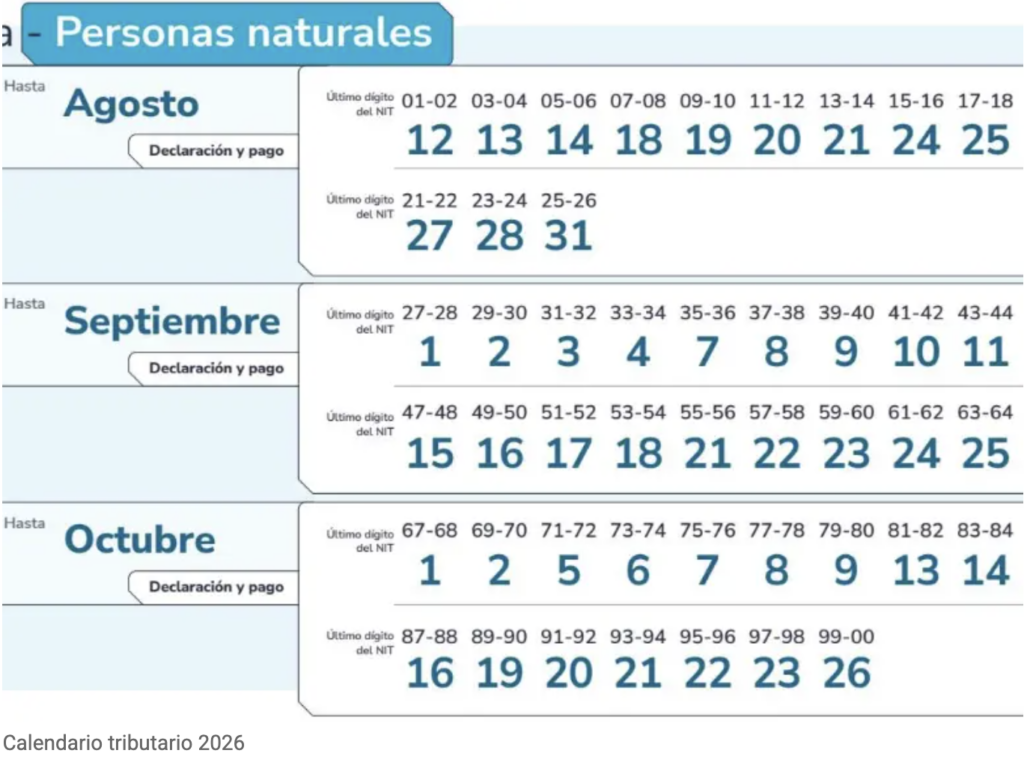
Source: El Colombiano
Find the last two digits of your NIT (usually your cédula de extranjería number) to find your deadline:

MEET SARAH
Welcome! I’m Sarah. I started this blog to be a resource for others around a few of my favorite things: living in Colombia, DIY projects, places traveled, and day-to-day life. My hope is that it can a place of inspiration and encouragement to help you plan the next project or adventure of your own!
Let's connect
Featured posts



Categories
When I first moved to Colombia, I was four months pregnant with my second child. Thankfully, I had some idea of the appointments I needed and what to expect after having my first child in Colorado. However, I still searched for resources on navigating pregnancy in Colombia. Now, having just had my third baby—my second born in Medellín—I wanted to organize my notes for current and future expecting mothers looking for support and planning to have their babies here too.
This guide has been compiled from various Medellín communities, word-of-mouth suggestions, and recommendations from my obstetrician. It includes:
- Emergency Hospitals
- Obstetricians
- Doulas
- Pelvic Floor Therapists
- Perinatal Psychologists
- Prenatal Classes
- Prenatal Fitness
- Prenatal Massages
- Maternity Clothing
- Baby Stores – New
- Baby Stores – Used
- Baby Furniture
Below I’ve included some clarifying notes for each section.