
Registro Civil de Nacimiento
What You Need to Know Before Registering a Birth in Colombia
Before you head to the notaría or registraduría, here’s a quick overview so you know what you’re walking into.
The deadline, birth-document and nationality guidance, plus passport fees, booking, payment, pickup, photo guidance, newborn EPS/follow-up information and the U.S. citizenship/CRBA overview below, were checked against official sources on October 24, 2026. My appointment stories and personal cost breakdown come from my original 2024 account.
The registro civil de nacimiento records your baby’s birth. Registering a birth and establishing Colombian nationality are separate questions—having a Colombian birth record does not, by itself, settle nationality. See the nationality section below before making passport plans.
My experience was as a Colombian mom registering my children born in Medellín. I’m Colombian through my mother, who was born and raised in Bogotá; my partner had an M visa. That context matters when comparing my paperwork with your family’s situation. The documents and copy costs below are what I brought and paid.
Birth registration itself is free; the copy costs I describe are separate.
Where to Register: Notaría vs. Registraduría in Colombia
For a birth in Colombia, start by asking about these registration options:
- At the hospital: Ask whether it offers birth-registration services, who handles them and on which days.
- At an authorized civil-registry office: This can be a Registraduría or an authorized notaría. Confirm the arrangements with your chosen office. See the one-month deadline and late-registration guidance below.
Be aware that the notary representative at the hospital may be from a notaría far from where you live. Ask which office they are from and keep its details with your child’s records.
For future copies, the original notary is not always your only option. The Registraduría’s current copy-request guidance directs people outside the city of registration to authorized Registradurías; its list includes Medellín. Records kept in tomo y folio format have an original-office restriction. Confirm availability for your record before travelling.
When I asked the notary representative where parents should go if neither of them are citizens but are instead in Colombia on visas, she recommended the Registaduría as opposed to a regular notary.
I obtained copies of my own consulate-registered marriage record through Notaría Primera in Bogotá. That does not establish it as the only office for every consular record. Confirm where your record is held and which copy format the receiving office needs before choosing a route.
The Registraduría offers a digital-copy route for records available in its system; those copies exclude marginal notes. Official copy procedure. I’ve shared my experience and the current options in my guide to getting a copy of a consulate-registered registro civil.
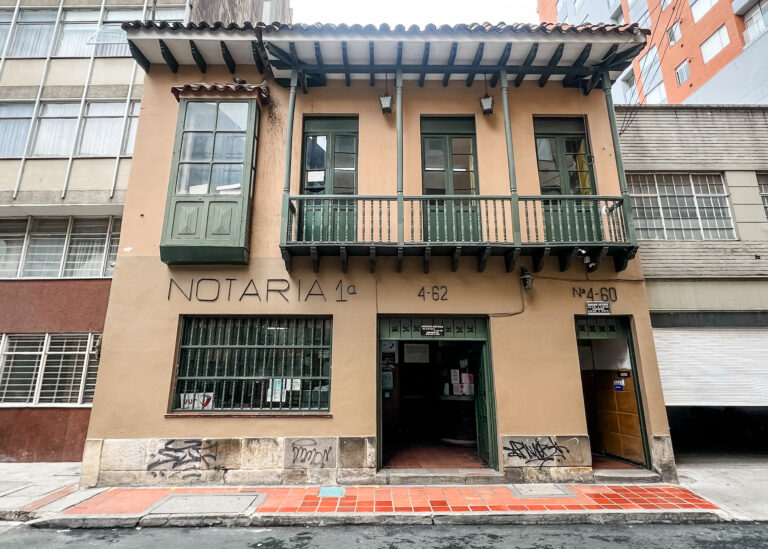
I opted to do it at the notaría where we registered my son, which was different from the hospital notary representative’s home office.
If at Least One Parent Is a Colombian Citizen
If your baby is born in Colombia and has a Colombian parent, that is one of the grounds for Colombian nationality by birth under Law 2332, article 4. Ask your chosen office which identity and birth documents to bring, and arrange registration within the month following the birth.
This was my path. I registered both of my children born in Medellín at the same notaría I’d used before. Familiarity with the process and the staff made it much smoother the second time around!
If Both Parents Are Foreign Nationals
Having two foreign parents does not create a blanket rule that you must use a Registraduría instead of a notaría. The official registration FAQ lists both as places to register. The hospital representative’s recommendation above was the advice I received.
Ask the office to review your child’s date of birth and your family’s documents for nationality purposes. A valid visa alone is not enough to assume eligibility. The nationality section below explains the current domicile guidance and exceptions. Birth registration must still proceed if parents have not proven domicile; the circular distinguishes that from proving nationality.
Ask which supporting documents your case actually requires before paying for apostilles or translations. The official birth-registration guidance specifies an apostilled or legalized foreign birth record, translated where applicable, when the birth occurred abroad. That is a different situation from using the hospital certificate for a baby born in Colombia; it is not a blanket instruction to apostille every foreign parent’s passport.
What I Brought for My Children’s Birth Registration
Here’s what I brought for my children’s registrations. I always recommend checking the current requirements with your office before going—my extra paperwork is not a universal checklist.
The Registraduría FAQ says parents who state they are married are not legally required to present their marriage registration for this purpose. Its current requirements call for a separate blood-group/Rh result when the supporting birth document is something other than the certificado de nacido vivo. I’ve kept what I brought below as my experience.
- Baby: Footprints are taken at the appointment
- Lab results: Showing blood type and Rh factor
- Certificado de nacido vivo
- Your cédula and a photo copy of the cédula
- Your partner, their cédula or passport, and a photo copy of their identity document
- Your registro civil de matrimonio
- A copy of your partner’s visa (not needed but brought just in case)
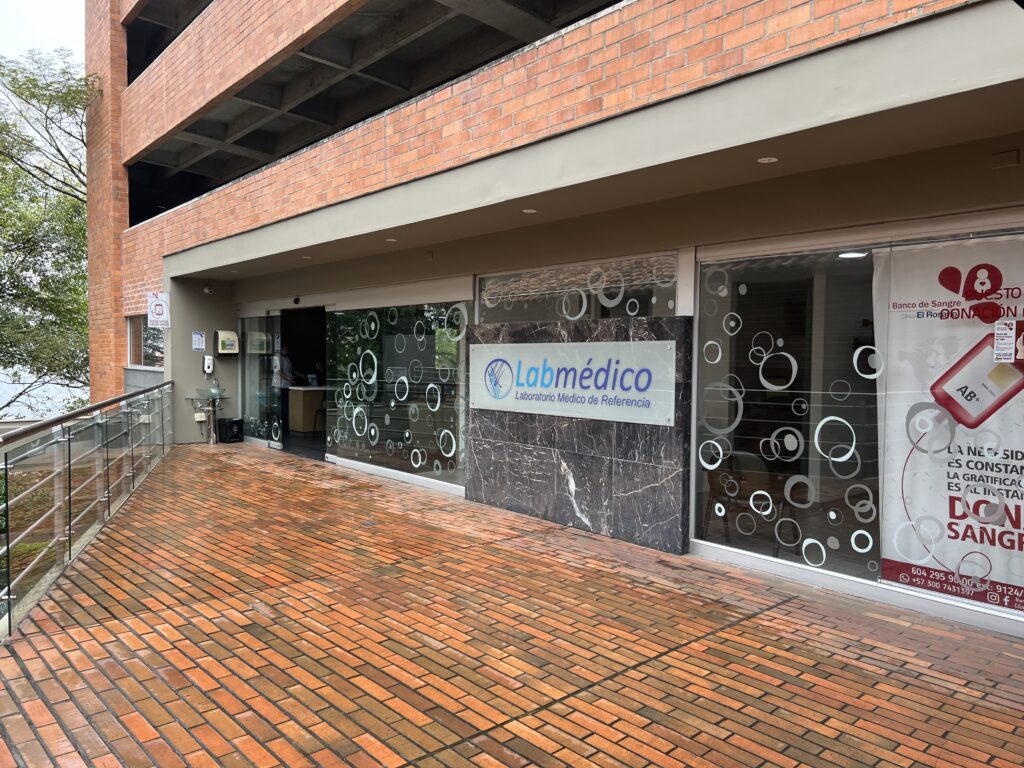
On the day my babies were born, my gynecologist gave me a “Certificado de nacido vivo.” The notary keeps the original, and the copy is for your records. Additionally, lab work showing the baby’s blood type and Rh factor is submitted. The first time, I picked up the results at Clinica El Rosario 2-3 days after I was discharged. The second time, I stopped at the laboratory (Labmédico) on our way out to provide my email address. It’s located on the left-hand side next to “Doggers” as you exit the hospital and approach the parking garage. I received the results via email the day after we were discharged.
Step-by-Step: The Registro Civil de Nacimiento Process
At the notary, there’s a dedicated desk for “registro civil.” You can’t make an appointment so it’s good to get there early when it is less likely that there is a line. We provided the agent with the documents listed above, and he asked for:
- Child’s full name
- Address
- Phone number
Biometrics, Baby Footprints, and Your Baby’s NUIP
While completing the information, the agent asked my partner to complete his biometrica (biometrics). This legal requirement guarantees the highest security in terms of identification for notarial procedures by comparing fingerprints against the National Registry of Civil Status database. (Source) Once this was complete, my partner signed the registro civil, and the agent took my baby’s footprints.
At this point, your baby is assigned their NUIP, the Número Único de Identificación Personal (Unique Personal Identification Number). You’ll find it on the top left-hand side of the registro civil. This number stays with your child for life. Save a photo of the registro civil on your phone! You’ll be asked for the NUIP often as you update records and arrange documents such as a passport.
Newborn care and EPS enrollment should not wait for the NUIP. See the EPS and first follow-up guidance below.
How Many Copies to Request (and What They Cost)
The agent then printed the four copies of the registro civil I requested, stamped, and dated each copy. These copies were for:
- Colombian passport application
- U.S. Consular Report of Birth Abroad (CRBA) and passport applications: I set aside two copies for these. That was my paperwork plan; follow the embassy’s current checklist for the required birth-record format, originals and copies.
- To keep in my passport holder. Colombian migración agents and airlines often request the registro civil de nacimiento to prove parentage to mitigate child trafficking and ensure children’s safety, even when both parents are traveling with the child. I always carry physical copies for all three kids.
We paid 59,700 COP for the four copies and then walked over to the side of the room where the notary finally signed.
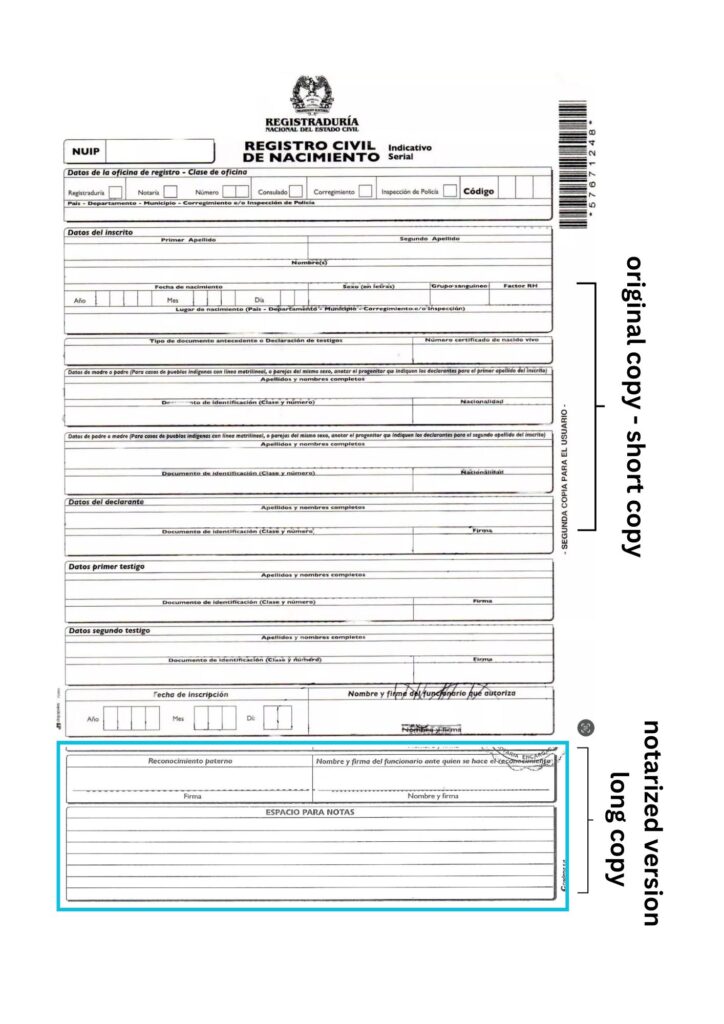
The notarized version is both the original copy plus the box highlighted in blue and sometimes referred to as the “long” copy.
When you leave the notaría, you’ll receive the original copy, or the top part of this document along with the notarized copies. Save it for your records.
I brought both the original and the long, notarized copy to my passport appointment.
Understanding the NUIP: Colombia’s Unique ID Number for Babies
The NUIP (Número Único de Identificación Personal) is Colombia’s equivalent of a Social Security number, except your child receives it at birth and carries it for life. It was introduced in 2004 to replace the older PIN system and ensure every Colombian citizen is identified by a single number from birth to death.
Your child’s NUIP will appear on every identity document they ever receive in Colombia:
- Registro civil de nacimiento (birth certificate) that’s assigned at registration
- Tarjeta de identidad: Required at age 7
- Cédula de ciudadanía: Issued at age 18
Once you have the NUIP, keep it handy when updating your baby’s health and vaccine records or applying for a Colombian passport. But don’t wait for birth registration to arrange newborn care: the healthcare and EPS steps below begin before you leave the hospital.
Birth Registration Deadline: One Month and the Late-Registration Route
The official registration period is within the month following the birth. After that, registration is considered late (extemporánea), but you can still register. Registraduría’s deadline guidance. I would still try to get this done early—there’s enough to keep track of with a newborn.
Missing that first month does not automatically make the hospital’s certificado de nacido vivo unusable. The Registraduría FAQ expressly allows presenting it for a later registration.
Late registration has its own process, including a declaration that the birth has not already been registered. Witness statements are a fallback when the birth cannot be established with the accepted documents, rather than an automatic requirement after the first month. Ask your office what to bring. Decreto 356 de 2017, article 2.2.6.12.3.1.
If you’re also sorting out nationality or a passport, ask about those requirements separately. Bring your family’s documents and explain the child’s birth date and your circumstances; use the nationality guidance below rather than treating a current visa as the answer to every question.
Additional time-sensitive items to keep in mind:
EPS, First Follow-Up and Newborn Screening
Start before leaving the hospital. Ask the hospital and EPS to confirm your baby’s enrollment and follow-up arrangements. Minsalud’s March 2026 guidance (section 3.2.d) calls for a booked, explained follow-up appointment before discharge, based on the baby’s risk and condition. High-risk newborns need a pediatrician; low-risk newborns may be seen by a medical doctor. Follow the discharge plan rather than assuming every baby has the same appointment interval.
EPS enrollment: Decreto 780, articles 2.1.3.5 and 2.1.3.10 provides for affiliation from birth, normally through the mother’s EPS, using the certificado de nacido vivo while the registro civil is pending. If neither parent is enrolled, ask the hospital’s affiliation team for help. Supply the registro to the EPS when available; the rule allows up to three months when it is needed for that record. That is separate from the one-month birth-registration deadline. Late paperwork must not interrupt the baby’s care.
Lab results: Bring the discharge information and screening results you have, including TSH (thyroid-stimulating hormone) screening for congenital hypothyroidism. If results are pending, keep the follow-up appointment and ask how to obtain and review them. The newborn-care guidance in Resolución 3280, section 4.12.6.1 explicitly covers outstanding screening results.
My insurance paperwork: Once I had the registro civil, I forwarded it to my insurance agent to add my baby to our plan. That was my experience with our plan; it doesn’t mean EPS enrollment or newborn care should wait for the registro. Check any additional plan’s paperwork with the insurer.
For more details, visit the Registraduría’s website.
How to Apply for Your Baby’s Colombian Passport in Medellín
There are four steps to getting your baby’s Colombian passport: make the first payment, book an appointment, attend with your baby and complete payment, then collect the passport. I’ve done this twice in Medellín, and the process was consistent both times.
Below, I’ve kept my experience alongside the current official guidance. Before making plans, check the nationality requirements and the documents needed for your family’s situation.
Step 1: First Payment and Current Passport Fees
Start at Antioquia’s official passport portal to make the first payment. Use its “Pasos para el trámite o renovación del pasaporte” instructions.
These were the details I used when making the payment. Follow the fields shown in the current portal:
- Child’s NUIP
- Full Name
- Parent’s email address
- Cell phone number
- Select the type of passport
- Proceed and finalize payment
Passport fees in Antioquia — reviewed October 24, 2026
You can choose an ordinary passport (32 pages) or an executive passport (48 pages). Both have a ten-year validity period. Cancillería explains the passport types.
| Passport | First payment (COP) | Second payment (COP) | Total (COP) |
|---|---|---|---|
| Ordinary | 199,000 | 116,600 | 315,600 |
| Executive | 199,000 | 256,400 | 455,400 |
These standard totals are calculated from Antioquia’s published first payment and Cancillería’s current national tariff. Confirm the amount shown by the official payment instructions before paying. My original costs are kept in the personal breakdown below.
Things to Note
- Antioquia’s current instructions say payment and booking open Monday–Friday at 8 a.m., until that day’s available capacity is filled. They list PSE or authorized correspondents through Placetopay for the first payment.
- One morning, I had issues with Bancolombia, and by 8:07 a.m., all slots were taken. I had to try again the next day. That was my experience, not a fixed daily cutoff.
- I used Bancolombia via PSE, and my payment processed immediately. Allow for the payment method’s processing time.
- Keep the date of your first payment and the confirmation email handy. I recommend bringing a copy of the payment confirmation to your appointment.
Step 2: Schedule appointment
After the first payment, return to the same official Antioquia portal to request your appointment. Choose from the dates it actually offers.
When I booked, these were the details I needed. The current form may look different:
- Your child’s NUIP
- Date of the first payment
- Type of passport requested
- Select the date and time
Things to Note
Have your calendar ready before you start. I was able to make my first payment and schedule our appointment on the same day (a Wednesday), with the appointment two days later on Friday. That is my own timeline; it isn’t a rule that appointments can only be booked two or three days ahead.
Step 3: Attend the Passport Appointment — Documents and Payment
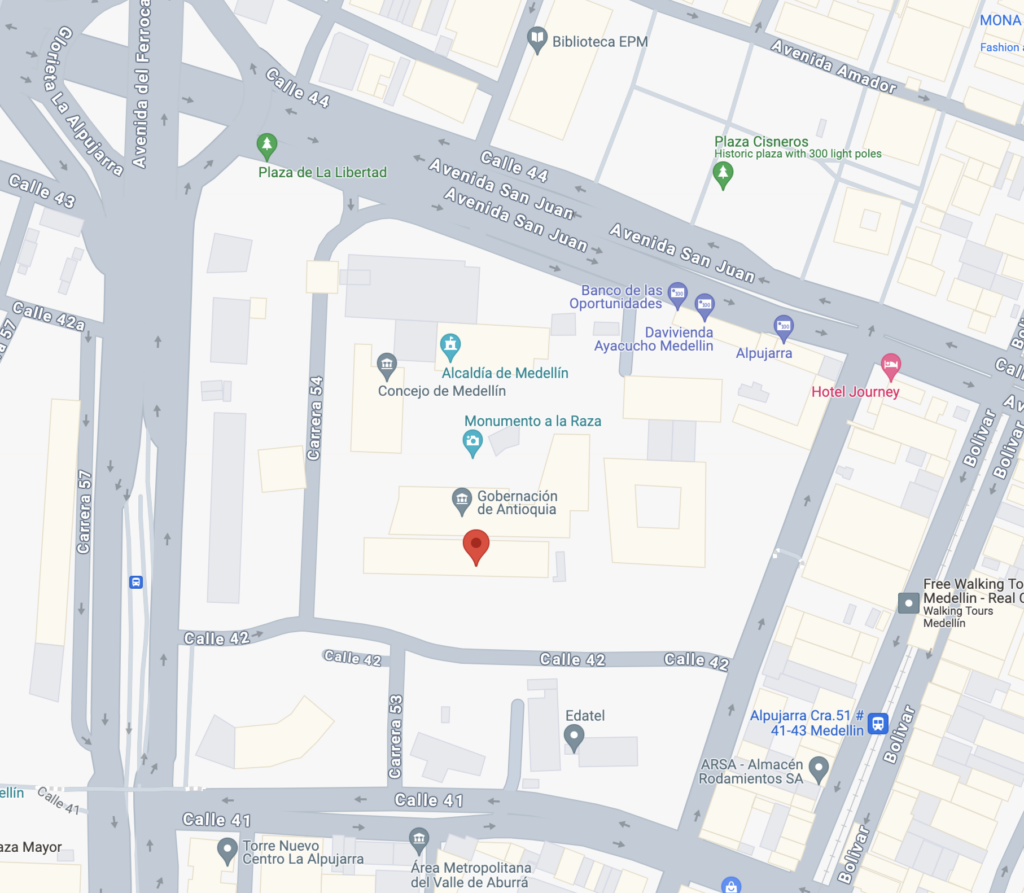
The Dirección de Pasaportes lists the application office at Calle 42 #52-106, La Alpujarra. My appointment was on the first floor. I’m the Colombian parent in our family; my partner came with me just in case.
Current Cancillería guidance says one parent can accompany the child; authorization from the absent parent is not required in that situation.
Start with Cancillería’s current requirements for minors, article 21. For a baby, the birth record must be an authentic copy issued by the notary, registrar or consul, with space for reciprocal notes—not simply a notarized photocopy. The accompanying adult needs the appropriate identification, and additional nationality evidence can apply, especially for children of foreign parents. Ask the office which documents fit your case.
Based on my experience obtaining my son’s passport in Colombia, I knew what to bring. Also based on my experience of doing anything in Colombia and to avoid multiple trips, I brought extra documents just to be safe.
What I Needed at My Appointments (My 2024 Account):
- Baby: They took the baby’s picture at the appointment.
- A soft, thick baby blanket: To cushion the baby for her photo; the office provided a white sheet for the background.
- Baby’s registro civil de nacimiento: I brought the legal-paper-size copy from the notary. See the current authentic-copy requirement above.
- A copy of my registro civil de nacimiento.
- My cédula and a copy.
- A copy of my mother’s cédula: Since I got my citizenship through her.
- Cash for my final payment: This is how I paid. It isn’t a current cash-only rule; see the payment guidance below. The nearby Bancolombia ATM can have long lines.
What I Also Brought Just in Case
- Baby’s registro civil de nacimiento: The original, short version.
- A copy of my partner’s cédula.
- A copy of my partner’s visa.
- A copy of our registro civil de matrimonio.
- Electoral certificate: A correction to my original checklist: the passport discount is a benefit for the voter. Don’t assume a parent’s certificate discounts a baby’s passport.
Tips for Your Baby’s Passport Photo in Colombia
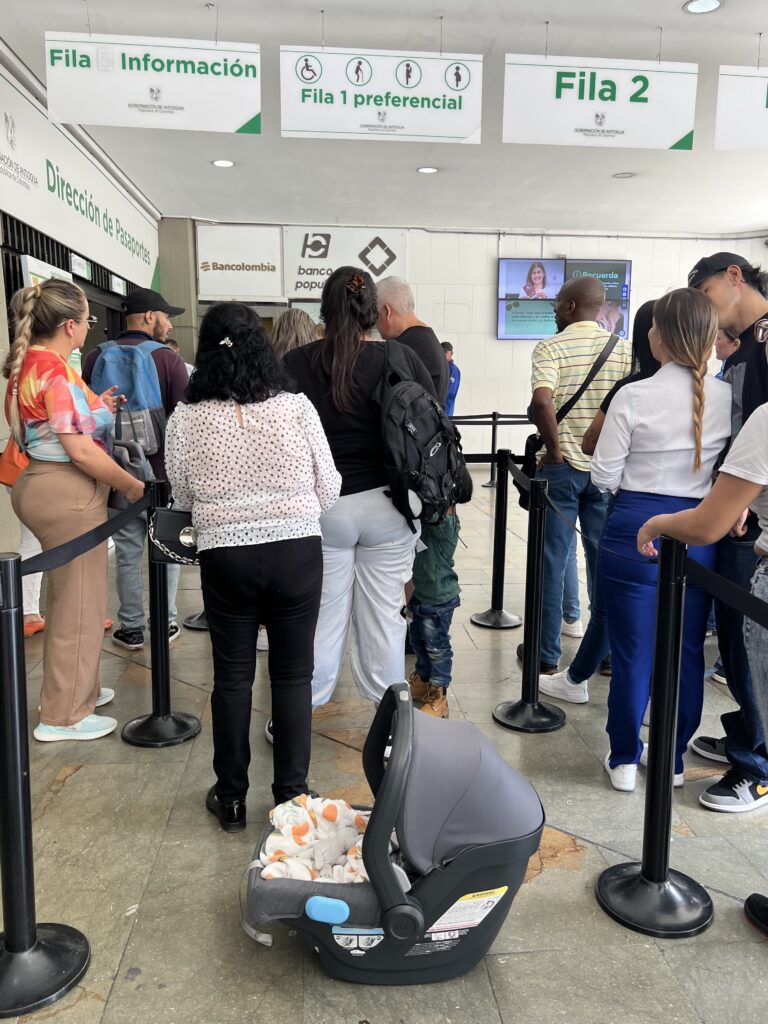
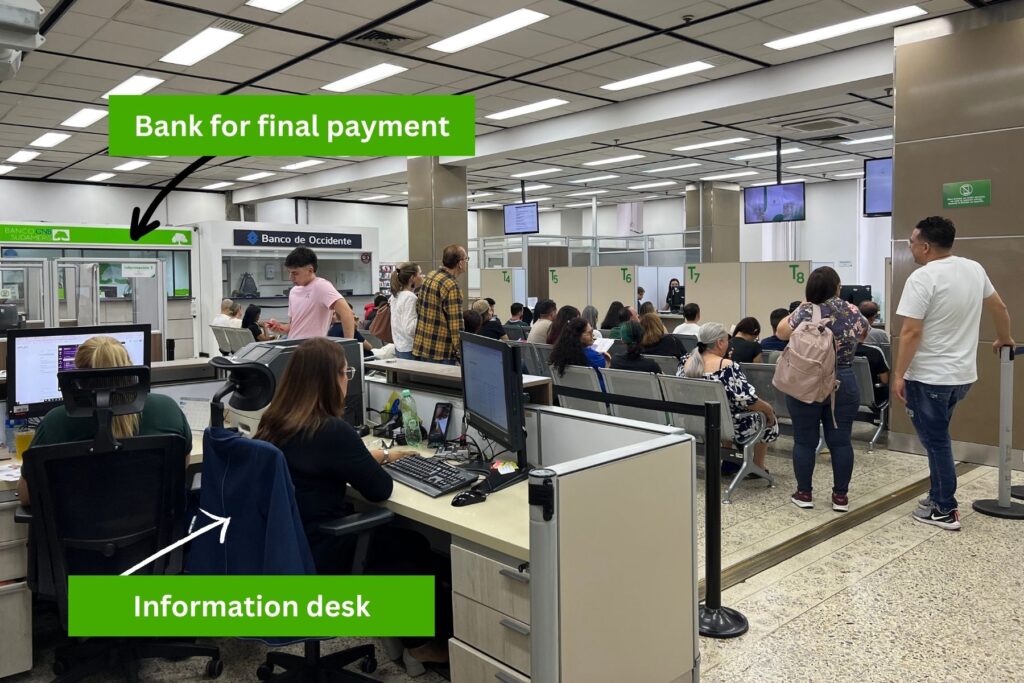
When you arrive, be sure to go to the “Fila Preferencial” (priority line) for the elderly, people needing special assistance, pregnant persons, and those with young children. Someone will check you in to verify your appointment and documentation. Then, you’ll head over to the information desk where they will begin processing your paperwork.
Cancillería’s requirements for minors say the photo is taken at the appointment, so you don’t need to bring printed passport photos.
I provided all the documents, and the agent entered our daughter’s information for her passport. After a few minutes, we laid the baby blanket on the desk, the agent placed the white background sheet over it, and laid our daughter down for her photo.
Cancillería’s published baby-photo guidance (Circular 56 of 2012) describes a plain white or light background, open eyes and no visible supporting hands. It allows photographing a baby lying on a blanket. Let the staff guide the positioning and confirm their current instructions; the blanket and sheet setup above is how it worked for us.
After checking the passport information and signing, follow the office’s instructions for the second payment. I paid cash at the office near the main entrance. Keep the receipt.
Cancillería’s current payment guidance also lists PSE, GNB Sudameris, Visa/Mastercard at passport offices and Servibanca. Confirm which options the Antioquia office offers for your application. Pay on the day the reference is generated; if it expires, obtain a new reference.
Step 4: Passport Pickup — Timing, Hours and Documents
Last step! Both times I applied, the passports were ready within a week. Cancillería currently lists 48 hours for gobernaciones, but says local logistics can affect delivery. Confirm readiness before making the trip.
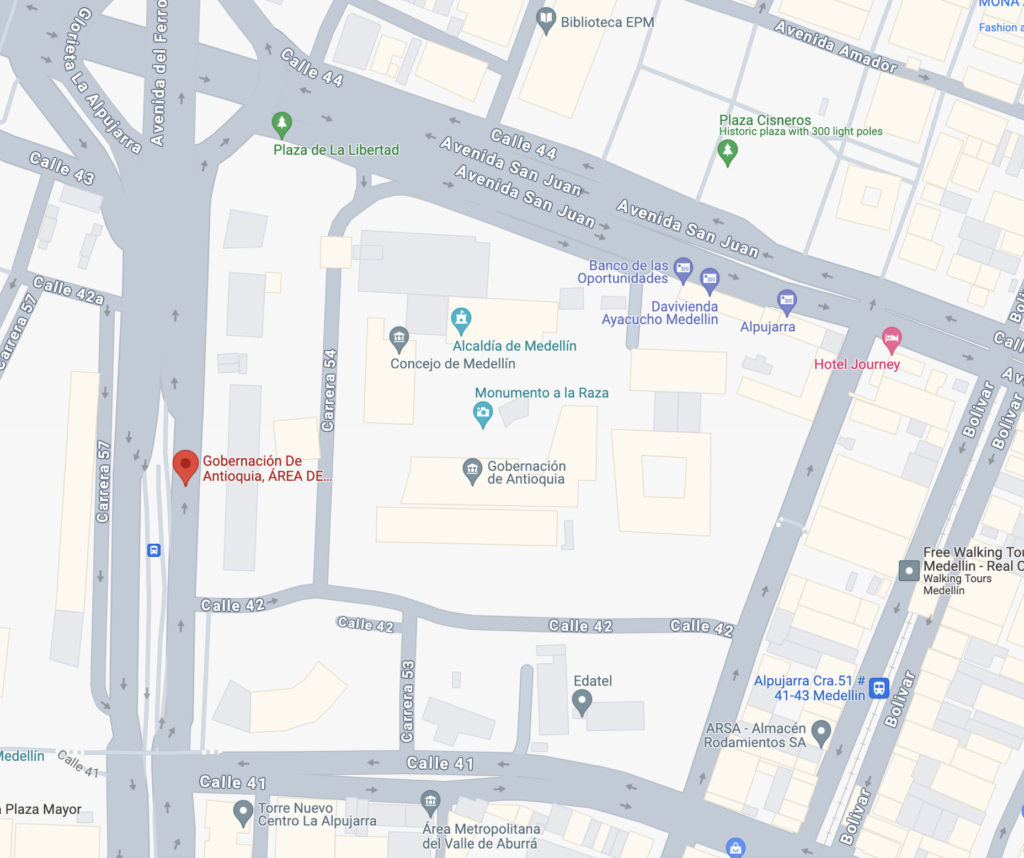
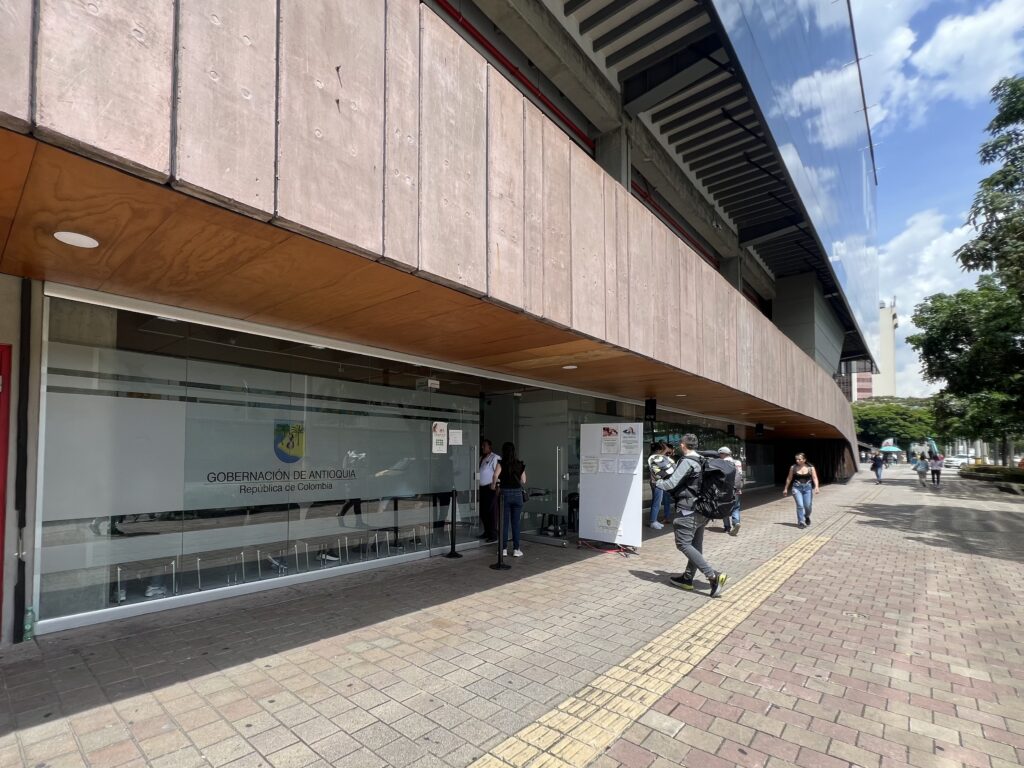
The pickup office is around the corner from where you apply: Carrera 55 #42-56, Plaza de La Libertad, local 4256. I collected my child’s passport, but being Colombian is not what determines who can collect. The collecting adult must be the same parent, legal representative or authorized adult who applied with the child.
The dedicated passport-office page lists these pickup hours. Reconfirm before travelling, especially around holidays:
- Monday–Thursday: 7:00 a.m.–4:30 p.m.
- Friday: 7:00 a.m.–3:30 p.m.
- Saturday: 8:00 a.m.–noon.
The map below is from my original account. Use the current office address above when planning your route.
What You Need:
Bring your own identification and your child’s registro civil (or tarjeta de identidad, as applicable), as set out in Cancillería’s delivery guidance. For a foreign accompanying adult, the collection FAQ specifies a passport or cédula de extranjería, as applicable. Keep your payment receipt and the child’s NUIP handy too. Ask the office about the accepted document format and whether your baby needs to accompany you; don’t rely on a digital copy or priority access being available.
I received an email two business days after our appointment informing me that my child’s passport was ready for pickup. Follow the office’s current collection instructions, and ask staff about the priority line if you come with your baby. Review the passport’s details before leaving, then you’re good to go!
My 2024 Registro Civil and Passport Costs
| Item | Cost (COP) |
|---|---|
| Four notarized copies of the registro civil de nacimiento (~15.000/copy) | 59.700 |
| First payment for ordinary passport | 172.000 |
| Final payment for ordinary passport | 136.000 |
|
Total: |
367.700 COP or ~$95 USD |
Does Colombia Offer Birthright Citizenship?
Being born in Colombia does not, by itself, establish Colombian nationality. For a baby born here, the ordinary grounds are a Colombian parent or, when both parents are foreign, a parent domiciled in Colombia at the time of birth. Law 2332, articles 4–5.
For births governed by Law 2332, the Registraduría’s current guidance says the ordinary visa route requires three continuous years of qualifying M or R visas before the birth. Simply holding a work, student or marriage visa does not answer that question. The circular specifies which visa sequences count.
Special provisions apply to PPT/PEP Tutor holders and recognized stateless children; births governed by the earlier law are treated differently. Ask the Registraduría to review your documents and the child’s birth date. Circular Única, version 9, sections 3.12–3.12.2. Visitor status alone does not establish domicile under Law 2332, article 4.
If you’re not sure whether your visa status qualifies, I’d strongly recommend consulting an immigration lawyer before the baby arrives. It’s much easier to sort this out ahead of time than to deal with it while also adjusting to life with a newborn. Seriously.
What Comes After the Registro Civil: Next Steps for Families
The paperwork train keeps moving, but some steps start before you have the registro civil in hand. Arrange newborn care and EPS enrollment with the hospital before discharge; use the registro to update the paperwork afterward. Here’s a quick roadmap:
- Colombian passport: For eligible Colombian children, see the passport document requirements and current Antioquia fees above.
- EPS enrollment: Confirm this with the hospital and EPS before discharge. See the enrollment guidance above, including what to use while the registro civil is pending.
- First newborn follow-up: Confirm the booked appointment and discharge instructions before leaving the hospital. Bring available screening results; the follow-up guidance above explains what to do if results are still pending.
U.S. citizenship and CRBA (if applicable): A child born in Colombia may acquire U.S. citizenship at birth through a U.S. citizen parent, but parent citizenship alone does not establish eligibility. The parent’s prior U.S. residence or physical presence and the family’s circumstances matter. Check the State Department’s transmission requirements.
A Consular Report of Birth Abroad (CRBA) documents citizenship acquired at birth; it is not a birth certificate or travel document. Apply before the child turns 18.
Follow the U.S. Embassy in Colombia’s CRBA instructions for the online application and in-person interview in Bogotá or Barranquilla. You can apply for the child’s U.S. passport at the same appointment, using the CRBA appointment process rather than booking a passport-only appointment. Your child must attend.
I share my experience in my CRBA, U.S. passport, and Social Security guide. Use the embassy’s current checklist when preparing your own application.
- Tarjeta de identidad: This won’t be needed until your child turns 7, but it’s good to know it’s coming. Turning 7 does not itself require replacing a valid passport. Cancillería’s current FAQ says the same for turning 18, but recommends checking the destination’s requirements before travelling.
Frequently Asked Questions About Birth Registration in Colombia
How long do I have to register my baby’s birth in Colombia?
Register within the month following the birth. If that period has passed, ask about late registration; the hospital certificate can still be presented. See the deadline and document guidance above, including the official sources. Check with the hospital or chosen office about service availability before going.
What is a NUIP in Colombia?
NUIP stands for Número Único de Identificación Personal (Unique Personal Identification Number). It’s assigned at birth registration, appears on the registro civil de nacimiento and stays with your child for life. Keep it handy for identity documents and record updates. It is not a reason to delay newborn care: see the EPS and follow-up guidance.
Does my baby automatically get Colombian citizenship if born in Colombia?
Not simply because the birth took place in Colombia. Birth registration alone does not establish nationality. Check the nationality criteria, current domicile rules and exceptions above for your family’s situation, rather than assuming any valid visa is sufficient.
What’s the difference between registering at a notaría vs. a registraduría?
The official FAQ lists notarías and Registradurías as registration offices. Foreign parentage alone does not exclude the notary route. Ask your chosen office about your documents and arrangements.
For future copies, check the official copy-request guidance. Moving from Bogotá to Medellín does not automatically mean travelling back for a copy: an authorized Registraduría may be able to help, depending on your record. Confirm availability and the required format first.
How much does it cost to register a birth and get a Colombian passport?
Birth registration itself is free. In my original 2024 account, four registro civil copies cost 59,700 COP, and the ordinary passport cost another 308,000 COP. Those are historical costs. See the current passport fee breakdown above, and confirm copy prices with the office issuing your records.

Leave a Reply