This post may contain affiliate links. Read my full disclosure here.
If you’re considering relocating to Medellín with kids, these questions come up quite a bit in both the United States and Colombia. Even Colombian family members were confused and surprised when we told them about the move, but it’s been a few years in the making: my partner and I are fortunate enough to work in fields where remote work is possible, so it was always a possibility; I’m lucky to have Colombian citizenship, which greatly helps alleviate visa concerns; and I’ve moved around enough to know that if it doesn’t work out, we can always go back. Already decided to move? Check out my Moving to Medellín with Kids: Complete First-Year Checklist for a step-by-step action plan.
A note on timing: I first published this story in May 2024, while pregnant with my third child, and later added the three-plus-year reflection below. I’ve kept those experiences and older costs in their original context. The factual guidance was reviewed in October 2026; the prices are not current quotes.
These are the top 4 reasons why my family and I moved to Medellín:
In this guide
- Why Medellín? Our Family’s Colombian Roots
- Exploring Colombia’s Biodiversity with Kids
- What Family Life in Medellín Actually Costs
- The Quality of Life Upgrade We Didn’t Expect
I’d be remiss if I didn’t include some of the challenges that have come with the move, so to keep things honest, I’ve also added:
And the post is wrapped up with common questions and my honest take after being here a few years.
Why Move to Medellín? Our Family’s Colombian Roots


My mom was born and raised in Bogotá, Colombia. Growing up, my family and I spent many summer vacations visiting the relatives who chose not to immigrate to the U.S. Once my Abuelita (grandmother), started spending more time in the States, we traveled to Colombia less often. Though, I’d always felt a strong pull to return to spend more time in Colombia. It wasn’t until my mid-20s that I prioritized trips back, visiting almost every other year until moving to Medellín in my mid-30s.
In my 20’s, I applied for and received my Colombian citizenship as the child of a Colombian citizen. I didn’t have a specific move date in mind but knew I wanted to try living here at some point. I also figured it would be much easier to do as a citizen versus applying for various visas. I always liked the idea of raising kids in Colombia too. It was important to me that they be close to our roots, celebrating the culture through dance, food, holidays, speaking Spanish, and exploring the beautiful biodiversity of Colombia. Some of my favorite childhood memories are times we spent with family, in the mountains, or enjoying one of many aguas termales, or hot springs.
My partner and I spent five weeks in Colombia on our honeymoon at the end of 2019. That trip solidified our decision to eventually move here. Although we still didn’t have a set date, we figured it would be sometime after our first child was born. She arrived in Spring 2021, and we moved to Medellín in December 2022.
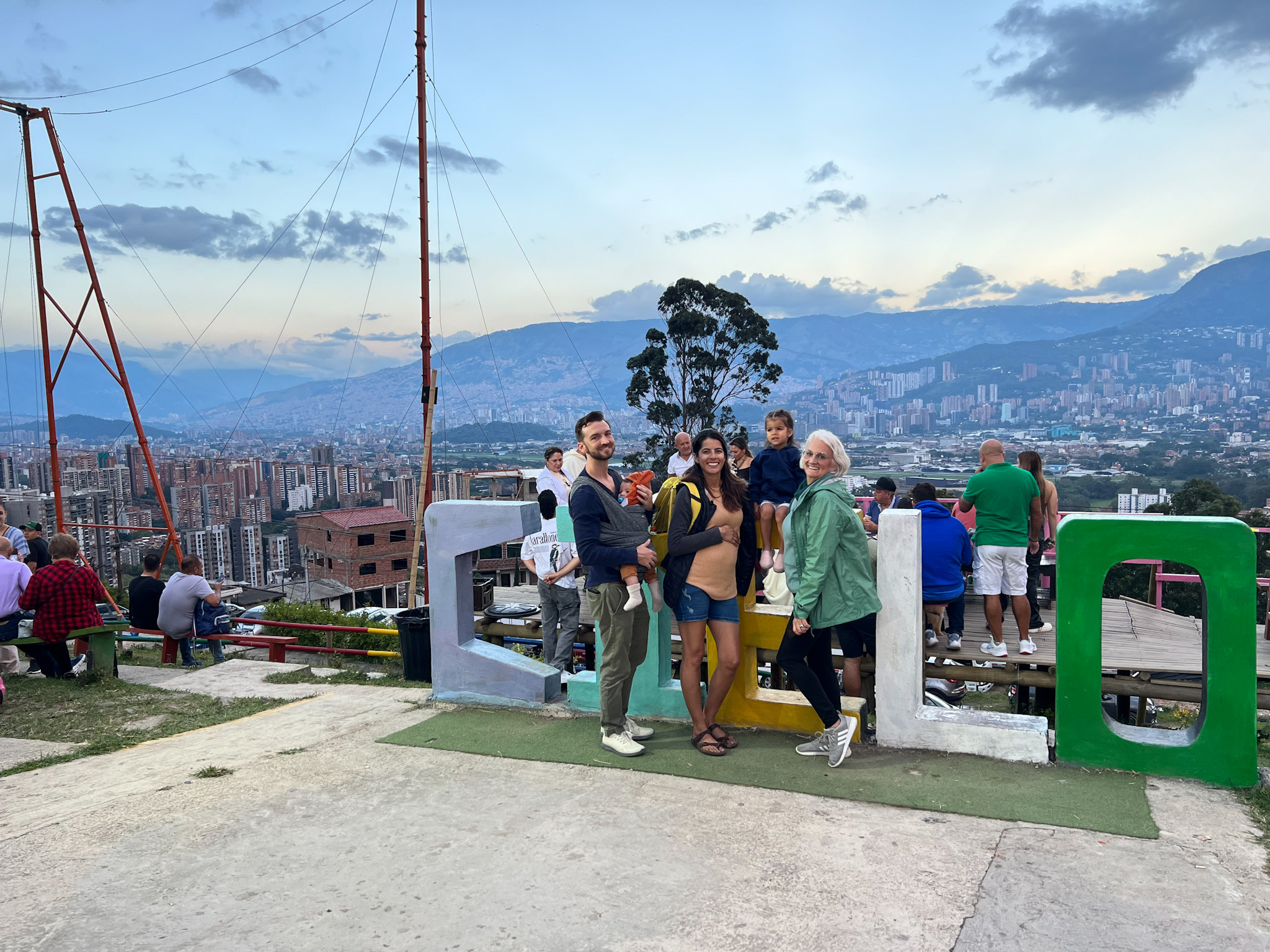
Why relocate to Medellín over Bogotá? I prefer the climate (it’s called the “City of Eternal Spring” for a reason) and the general ambiance of Medellín. I love being tucked in the Aburrá Valley. Although the pollution can be intense at times, the city’s green corridors add shade, help cool their surroundings and support urban biodiversity. They’re a welcome part of the city, though not a solution to all its air-quality problems. You’ll see lots of vertical gardens, shady tree overhangs over main roads, and huge monsteras growing freely on the hillsides. It’s gorgeous.
We still have family in Bogotá and love to visit. It’s a short flight from Medellín, though of course airport transfers add to the trip. Bogotá combines Washington D.C.’s government vibes (as it’s the capital of Colombia) with the dense urban environment of New York City. It’s much larger than Medellín.
Exploring Colombia’s Biodiversity with Kids


Colombia has it all: snow-covered volcanoes, the Andes mountain range, tropical beaches along the Caribbean and Pacific coasts, dramatic arid landscapes, Ciudad Perdida, or “The Lost City,” in the Sierra Nevada de Santa Marta, the Los Llanos grasslands, and of course, the Colombian coffee region and the Amazon rainforest.
Nature Facts About Colombia:
- Biodiversity: Colombia is one of the world’s most biodiverse countries. SiB Colombia’s 2025 release lists it first in bird, orchid and butterfly diversity.
- Species: That release reported 80,346 species documented through December 2024. This is a count of documented species, not everything that lives here, and the numbers change as knowledge grows.
- Birds: Colombia has nearly 2,000 bird species, including species found nowhere else.
- Orchids: Thousands of orchid species grow here. There is a lot to discover without even leaving the country!
I think Colombia has incredible potential for outdoor adventures. Safety still shapes how we plan them, though. Even on local hikes around Medellín, I’ve heard stories of people getting robbed. It’s a reason to check recent local advice for the specific route, leave valuables at home and go with a group or a reputable guide where appropriate. Neither a group nor a guide makes a route risk-free.
That said, I’ve found well-reviewed camping spots on private property where I’ve felt comfortable paying to stay. There are also companies offering guided rafting and hikes in or near national parks. Check the particular route, operator and park’s current access rules before setting out; a good review is a starting point, not a safety guarantee.
When I first wrote this, I’d spent much of our time since moving to Medellín either pregnant or adjusting to life with a newborn, which is an adventure in itself, but wasn’t the outdoor exploration I was really looking forward to. I did spend some time in the Sierra Nevada del Cocuy the December before I first published this story, but couldn’t do all the hikes since I was at the end of my first trimester and honestly, I felt like shit. It was a breath of fresh air though and a quick taste of the outdoors I’d been missing. Since we shipped our things from the U.S. we have all our camping gear from our time in Colorado, and I was eager to get outside and share that joy with my little ones.
That is a past experience, not advice to hike at altitude while pregnant. El Cocuy’s official visitor guidance recommends against ascending during pregnancy. Check current park entry conditions, including children’s age restrictions, and discuss high-altitude travel with your clinician before planning a trip.
And as much as I love roughing it, I am also a big fan of accommodations with more creature comforts and everything in between. There are countless pueblos with beautiful architecture and Colombian charm, historical sites, and natural wonders. There are also places throughout South and Central America we’re looking forward to visiting. It reminds me of the quote by Susan Sontag, “I haven’t been everywhere but it’s on my list.”
What Family Life in Medellín Actually Costs
This section could easily be its own dedicated post, but here’s an overview based on our personal experience at the time of writing. My partner and I both work remotely, earning U.S. dollars while spending Colombian pesos. For us, living in the U.S. felt about 2–3 times more expensive than in Colombia. Here are the older comparisons I used, not a current price survey or a promise that every family will save the same amount. The U.S. figures are comparison estimates, and the dollar equivalents depend on the exchange rate.
One important budget item: taxes. Working for a U.S. employer or being paid in dollars does not settle where you owe tax. My older reply in the comments simplifies this: the Foreign Tax Credit and Foreign Earned Income Exclusion have different eligibility rules and limits, and neither guarantees that you only pay one country’s tax or eliminates every U.S. obligation. See my Colombian taxes guide and get advice for your own situation before comparing take-home budgets.
Rent for a 5 bedroom/3 bath
- Medellín: ~$2,500/month in Estrato 5
- USA: ~$4,200/month (based on our former neighborhood, 20 minutes outside of Denver)
Colombia uses a classification called estratos, from 1 to 6, for residential properties and public-service billing. It is not a direct classification of your personal income or a neighborhood safety rating. Estratos 1–3 generally receive subsidies, 5–6 pay contributions, and 4 has neither subsidy nor contribution surcharge; the details depend on the service and applicable rules. Check the actual bills for the home you’re considering.
Private health insurance: 2 adults, 3 kids
- Medellín: ~$5,150 for the year
- USA: Starting at ~$20,000/year without an employer subsidy, ~$12,000-$14,000/year with an employer subsidy
We chose SURA Global for coverage in Colombia and abroad, including the U.S. under our policy. International emergency travel assistance and scheduled treatment overseas are different benefits, with limits, exclusions and authorization requirements. Ask SURA for the current policy wording and a personalized quote rather than assuming our coverage or premium will apply to you.
Copays and deductibles depend on the policy and service; there isn’t a Colombia-wide no-deductible rule. Here’s what happened on one visit under our policy: in my 8th month of pregnancy I woke up with serious pain in my side, later finding out it was kidney stones. I spent 13 hours in the ER, was seen by the ER doctor, a gynecologist, urologist, had 2 ultrasounds, received liquids, pain meds, blood panels and a urine test ran and left with a copay of $19 USD at checkout. That’s it. I’m not anxiously waiting for a bill in the mail to see what else I have to pay after insurance… $19 and that’s it. That was my historical out-of-pocket cost for that visit, not a current ER quote.
I’ve been happy with our private plan, but I can only speak to our experience paying out of pocket and using that policy. EPS is part of Colombia’s health system, not simply a separate “public insurance” option; EPS administrators can be public or private. A private health policy supplements that system, and SURA currently requires active contributory EPS affiliation for Global. Networks, appointments and authorizations vary, so compare the actual providers and benefits your family needs rather than assuming private cover always means faster or better care.
Full-time Nanny (salary only, not including benefits)
- Medellín: ~$500/month, w/ overtime ~$1,000
- USA: ~$3,400/month
When I first wrote this, childcare costs were a significant factor in our decision to stay in Colombia until our youngest child is at least 5 years old and starting kindergarten. I was grateful every day for our nanny and the love and help she provided for my kids, especially while I was pregnant. Every pregnancy has been difficult, and when you add in chasing a toddler and an infant who’s toddler-sized, it’s a lot.
Regarding quality, nannies are common in Colombia, and many have significant experience. We were fortunate to find someone with certifications in early childhood education and previous work experience at a daycare, as well as with other families as a nanny. As in the States, it’s a similar process finding someone who’s a good fit for your family and thankfully we’ve had nothing but the best luck with niñeras here in Colombia.
Budget line items for self care spending had decreased drastically. Around the time I first wrote this, I got a dip manicure, gel pedicure, and a hair wash & blow dry for the equivalent of $61 USD total.
I could go on. The savings we experienced were significant and allowed us to allocate funds towards savings for ourselves and our kids, retirement, investments, travel, and extracurricular activities for the kids. At the time, I saw a meme about how the cost of summer day camps for one family in the US is equivalent to spending a week vacationing in an Italian villa. My oldest’s school was offering a summer day camp from 8a–2p. For 2 weeks, it cost $250 USD and included breakfast, lunch, materials, a few field trips, everything. That was the offer then, not a current camp listing.
The Quality of Life Upgrade We Didn’t Expect
Short answer as a mom of 3: Total upgrade.
Also common in Colombia and something we’re able to afford is an empleada, or employee, who helps cook and clean Monday through Friday. My partner’s always been the cook in the house so that part really helps him out the most. Cleaning has been my contribution in the relationship and let me tell you the mental load and time it’s freed up is absolutely liberating. It’s important to clarify that just because we have the help doesn’t mean we’ve stopped cooking or cleaning ourselves altogether. It’s still a team effort with our empleada taking the lead. My partner can still be found in the kitchen working with her to cook dinners once or twice a week and I’m still doing loads of laundry here and there too – and when I first wrote this, baking that baby was taking a lot out of me, so I was especially thankful for help getting things done that I just wouldn’t have been able to do.
As the mom of a very young family, the help around the house is huge. I’m not as stressed about household maintenance during the week, rushing to complete them before weekend plans with the kids. It was also hard being present sometimes with my daughter while I was worrying about the mountain of things that needed to get done at home. Not anymore.
Help with household chores and the support of our nanny allows me to take my oldest to her extracurriculars where I’m able to have dedicated focus and enjoy just her for that hour while my son’s being cared for at home. Same goes for my son’s swimming class. It’s something I feel lucky to be able to participate in with the extra peace of mind the extra help affords us. Date nights are easier to plan too!
In my experience, Colombia has felt SO much more family-friendly than the States. So many people we’ve met here love kids. I feel like the general sentiment in the U.S. is, “Your kid, your problem,” but that’s just not the vibe in Colombia. Especially when they’re infants, people love to ogle. Some examples:
- Traveling with Kids: When I’m traveling within Colombia with children and they’re throwing a fit on the plane or in the airport, people haven’t been scowling at my kids or giving me dirty looks. People have often tried to help by distracting the kids with funny faces, coos or peekaboo.
- Priority Boarding: While pregnant or traveling with our little kids, I’ve been offered priority boarding in the first group, alongside seniors and people needing assistance, as well as help at check-in. Expedited service so we can let the kids burn off energy in the lounge? Yes, please. Age cutoffs and procedures vary by airline and airport, so ask what applies to your flight.
- Preferential Lines: I’ve found a fila preferencial, or preferential line, in lots of places, and people often encourage us to use it when I’m pregnant or with little kids. Public authorities provide preferential attention to pregnant people and children, among other groups; at businesses, check the posted rules rather than assuming a universal age cutoff.
- Family and Accessible Parking: I’ve seen parking spaces with pregnancy and stroller symbols alongside the accessibility symbol. Follow the signs and the operator’s requirements: pregnancy or traveling with an infant is not blanket permission to use every space reserved for people with disabilities or reduced mobility, and documentation rules can differ.
Aside from family support, many businesses offer domicilio, or home delivery, which for some services is similar to what’s available back home, but the delivery fees in my original examples were usually $3–10 USD so it’s never a question of whether it’s worth it like it is in the States. This applies to pick-up and drop-off services like dry cleaning, baby gear cleaning, and rug deep cleaning, as well as at-home services such as massages, acupuncture, haircuts, nails, and blood draws. We’ve even used a domicilio doctor’s service several times for health concerns that didn’t need an ER visit, when we couldn’t get a doctor’s or pediatrician’s appointment or needed help after hours. On our past calls, they arrived within an hour of messaging them and we typically paid $40–65 USD. Those were our experiences; current availability, response times and charges can differ. Serious emergencies need emergency care, not a wait for a routine home visit.
Obstacles + Adjustments
Getting acclimated
This goes for any move, but depending on how good your Spanish is, it can be especially challenging. Then there’s a steep learning curve on how to do it all! For example, finding a home rental at a fair price when you don’t yet know the market. If you employ a niñera or an empleada, salary is only part of the cost: you also have obligations such as social-security contributions, prestaciones sociales and paid leave, including for part-time domestic workers. Current rules require a written domestic-employment contract. My empleada guide covers the current pay and employer obligations; the older dollar figures above are not a payroll formula.
For out-of-home childcare, guarderías (daycare), jardines infantiles (preschool) and private schools each have their own application process. Places and waiting lists depend on the school, grade and year, so contact the schools early rather than relying on a general wait-time estimate.
Schools, Childcare, and the Learning Curve
Then there’s the normal finding your physicians, pediatricians, dentists for you and your kids, and specialists you might need, new barber shop or hair salon, and so on. If you’re looking for more English-speaking providers, they do exist but your options might be more limited.
The Medellín International Moms (and Friends) Facebook group has been a really useful resource for me. I’d start by searching previous posts once you have access. Treat recommendations there as other families’ experiences and confirm current requirements with the relevant provider or authority.
Colombia Visa Options for Families Relocating to Medellín
My children and I have dual citizenship for the United States and Colombia. My partner needs the appropriate immigration permission to live here. The family routes relevant to us were the M spouse of a Colombian citizen and M parent of a Colombian national by birth, each with its own requirements. They can be granted for up to three years, but that isn’t a promise: my husband initially received one year, then two years the next time we applied.
I recommend beginning your preparation around three months before your current visa expires. That’s my practical planning advice, not a universal legal deadline or an automatic extension. A pending application does not by itself keep your stay lawful, so check your actual expiry date and what permission you need while it is processed.
It’s entirely possible to apply on your own, but we’ve hired a lawyer to do it on our behalf. Our first six months here were hectic, with adjusting to life with a then 1.5-year-old, my pregnancy and delivery with my second, finding a long-term rental, buying a car, and coordinating with the shipping companies for the arrival of our container from the United States. We didn’t want another thing to manage and needed to ensure our application was done correctly and on time.
Cancillería handles visa applications and decisions; Migración Colombia handles entry and stay records, visa registration and the cédula de extranjería. Some applications require documents from Migración, but it is not the agency that grants the visa. For those required to register and obtain a cédula, the application deadline is generally 15 calendar days after entry with a visa issued abroad, or after issuance in Colombia. Check category exceptions and children’s requirements.
Our experience with Migración was next-level hard and confusing. That was partly due to the law offices we used, and based on our experience with Langon, I felt treated like a number and would not recommend them. We’ve since heard more people have positive experiences with small, private practices, and our experience affirms that.
Our experience working directly with Migración felt consistently inconsistent. We ran into appointment-website problems and confusing payment instructions, including being told to go back online, make another appointment and pay again. That’s our experience, not a statement of the current procedure: check the official instructions for your particular trámite before paying. They were also less helpful with my husband, but when I intervened, we made some progress.
We’ve felt that frustration beyond Migración too, from notary and passport-office visits to trying to get banking tasks done. Sometimes the answers seemed to depend on the day and who we were talking to. It can be incredibly frustrating, but if you set the proper expectations, hopefully, it’ll be a little less disorienting.
If you’re interested in the Digital Nomad visa, my friend Liz wrote a guide to adding family members as beneficiaries, based on her family of five’s experience. Her article was updated in May 2025 and focuses on beneficiaries, not the main applicant’s process. Check the current Cancillería requirements alongside it: the V digital nomad visa has nationality, remote-work, income and insurance conditions, and is not permission to take Colombian-paid work.
Building Your Community as a Family in Medellín
One of the things I underestimated about this move was how much energy it takes to build a social circle from scratch. Especially with little kids in tow while juggling an international move, back-to-back pregnancies, newborn fog, and adjusting to life in general. In the US, your community often comes built-in through work, neighbors, or the school your kids attend. Here it’s similar, but you have to be more intentional about it. A lot of people are only here for a short while, and it gets exhausting having the same introductory conversation over and over again. We joke that it’s basically dating, but for friends.
The Medellín International Moms (and Friends) Facebook group was my starting point and remains one of the best resources for families here. Beyond that, our kids’ school has been our biggest social anchor. The parent WhatsApp groups, birthday parties, and school events are where most of our friendships formed. When I added this reflection, I was the mamá representante (class parent rep) for my daughter’s class, and as time-consuming as it can be, it’s connected us deeply with other families as well as the school itself.
I’ve also found community through shared experiences: other third-culture families who grew up between countries, and moms who understand what it’s like to be building a life far from extended family. It takes time. Not everyone stays long-term, and that’s okay. But the friendships that stick? They become your village.
If you’re considering this move, know that the community piece takes effort, but it’s out there! And Medellín is full of families who are doing the same thing you are. You can read more about navigating postpartum in Medellín for another perspective on building support here as a new parent.
Air Quality and Pollution in the Aburrá Valley
Medellín is located in the Aburrá Valley, where the terrain and weather can limit how pollution disperses. Transport and industry are important sources, and smoke from fires outside the valley can add to the problem. The Área Metropolitana identifies February–April and October–November as periods when pollution episodes have historically been more likely, not simply the dry seasons.
Pico y placa restricts driving by plate number and vehicle type. Medellín uses the last digit for private cars and the first digit for motorcycles; check the current rotation, hours and exemptions before driving. The green corridors I mentioned earlier add shade and help cool their surroundings, but we still need to pay attention to air quality.
Air pollution remains one of the things I weigh when living here. Conditions vary by day and monitoring station, so I wouldn’t assume every hillside neighborhood has cleaner air than the center. Check SIATA’s current air-quality information and nearby monitoring stations. If anyone in your family has a respiratory condition, discuss the move and outdoor plans with their clinician.
Is Medellín Safe for Families with Kids?
Colombia has a saying, “No dar papaya,” or “Don’t give papaya,” which means don’t give people any reason to pay you any mind or put yourself in vulnerable situations. This includes not wearing flashy jewelry, keeping your phone and wallet in a forward-facing fanny pack, and if you’re lost and trying to get your bearings, walking into the closest coffee shop or restaurant instead of sticking your phone out like you’re E.T. trying to phone home.
With our young family, we weren’t visiting places like Comuna 13 or partying in Provenza in the period I originally described. Our day-to-day routine felt very different from a nightlife-focused trip. Still, the U.S. travel advisory for Colombia applies to the country as a whole, including Medellín; it is not just about the Venezuelan border, sex tourism or dating apps. At this October 2026 review, the overall advisory is Level 3: Reconsider Travel, with some areas at Level 4. Read the current advice when planning your own visit or move.
Even as a local, I would be cautious with things like keeping your car windows down in certain neighborhoods and definitely keeping them rolled up at night. I witnessed a swift theft by people on motorcycles at 9pm on a Wednesday evening. The passenger on the motorcycle popped himself right through the back seat window of a car that had the window all the way down, grabbed what he wanted, and the driver sped off after.
Maybe surprisingly, I feel very safe, especially when I’m out and about with my family. I also recognize that my experience as a half-Latina, with the places and routines we know, won’t be everyone’s experience. That feeling isn’t a guarantee about any neighborhood or situation. Friends who don’t look Latino have also told me how kind and friendly people are, especially to their children. That warmth and people looking out for each other have been a big part of our life here.
If there’s more you’re looking for or curious to know about relocating to Medellín with your family, please comment below and I’d be happy to help if I’m able.
Is Relocating to Medellín with Kids Right for Your Family?
After three-plus years, here’s how I’d frame it for a family that’s seriously considering this move.
It might be a great fit if:
- you and/or your partner can work remotely
- you have ties to Colombia (cultural, family, or just a deep pull)
- you want your kids to grow up bilingual
- you’re craving a slower pace with more family support built into the culture
- you’re comfortable with some ambiguity and bureaucracy along the way.
It might not be the right move if you need to be close to extended family in the US or you’re not comfortable with a steep learning curve, especially without Spanish. If you or your kids need specialized medical care, confirm the particular clinician, treatment, medication and insurance coverage before deciding. A good experience with routine care doesn’t answer every family’s medical needs.
If you’re leaning yes, I put together a complete first-year checklist for moving to Medellín with kids, it covers everything from visas and housing to schools and healthcare, step by step.
What’s Changed After 3+ Years in Medellín
When I first published this post, I was pregnant with my third and we’d been in Medellín for about a year and a half. By the time I added this reflection, three-plus years in with three kids (two of whom were born here), I had a much fuller picture of what this life actually looks like long-term.
Some things have gotten easier. We know our barrio, we have our routines, the kids are settled in school, and we’ve built a community of families, both Colombian and from abroad, who feel like home. I’m no longer Googling ‘best pediatrician Medellín’ at midnight. We have our people now.
Some things are still hard. Bureaucracy doesn’t get less frustrating with time, sorry. Visa renewals, government offices, and bank processes still test our patience, and getting a straight answer still depends on who you talk to on which day. They’re a headache, not a deal breaker. You just develop a thicker skin and a longer fuse.
The city itself has felt different too. I’ve noticed more remote workers and families from abroad, and new family-friendly restaurants and spaces. Our cost of living was still lower than in the US, but I’d noticed costs creeping up, especially rents in popular neighborhoods. In this later reflection, my rough planning estimate for a family of four or five in a comfortable area with private school and childcare was $3,500–$6,000 USD/month, depending on lifestyle. That was an estimate, not our itemized bill or a current quote. The number of school places, employer obligations, insurance, taxes and exchange rate can change the total considerably.
The biggest shift, though, is internal. This doesn’t feel temporary anymore. Every time we come out of the second tunnel and see the valley open up in front of us, it just feels like home.
FAQ: Relocating to Medellín with Kids
Is Medellín safe for families with kids?
We’ve felt comfortable building our family life here, including walking together during the day and early evening in the places we know. By the time of my three-plus-year reflection, safety had never been a reason we’d considered leaving. That is our experience, not a promise that any neighborhood is crime-free. We keep a low profile, avoid flashing expensive items and research outings and hiking routes. Read the current Colombia travel advisory and assess the specific places and routines your family would use.
What visa do you need to move to Medellín with your family?
It depends on each family member’s nationality and circumstances. A qualifying spouse of a Colombian or parent of a Colombian national by birth may have an M visa route; being in a family with a Colombian does not automatically qualify everyone. The V digital nomad visa is another option for eligible remote workers who meet its conditions. Check Cancillería’s current categories.
For a trial stay, eligible visa-exempt tourists generally receive permission for up to 90 days initially and may request an extension, subject to approval and a maximum of 180 days in the calendar year. Follow the dates actually authorized; this is different from holding a V tourist visa. You can apply for a visa yourself, but we found a lawyer helpful with the paperwork.
How much does it cost to live in Medellín with a family?
Our family found the costs lower than in the US, but there isn’t one reliable total for everyone. The earlier rough estimates in this FAQ were $3,000–$6,000 USD/month for a comfortable family lifestyle and $800–$2,000+ for monthly rent; the later reflection above used $3,500–$6,000. These are historical planning ranges, not a current market survey or a guarantee they cover private school, a nanny and an empleada for your family. Our own five-bedroom rental comparison was about $2,500/month. Get current quotes in pesos and include all school fees, employment costs, insurance and taxes.
What are the best neighborhoods in Medellín for families?
Popular choices among families we know include Laureles and parts of El Poblado in Medellín, plus Envigado and Sabaneta, which are separate municipalities in the Aburrá Valley. The appeal among families we know includes Laureles’ residential streets and restaurants, Envigado’s more local feel and Sabaneta’s pueblo atmosphere. Walkability, hills, noise and convenience vary by address. Your school choice will likely influence where you live: the bus commute and early wake-up time matter a lot with little kids.
Can my kids learn Spanish if we move to Medellín?
Yes, children can learn Spanish through school, friends and daily life, but the pace varies and they need regular exposure, practice and support. Ask each school how it supports children who are still learning the language. Nannies, neighbors and playdates can give them more chances to use it too. It’s been one of the most rewarding parts of our move, watching our kids switch between languages naturally, and our oldest’s Spanglish is next level! Ha!
Sources
The personal stories and older prices are mine; the current factual guidance draws on these official and provider sources:
- SiB Colombia: Biodiversity in Figures 2025 and Colombia Travel: Ciudad Perdida.
- Medellín’s green corridors, SIATA air monitoring and the 2025 metropolitan air-quality report.
- DANE: estratos; SURA Global; UGPP: domestic workers and Decree 993 of 2026.
- Cancillería visa categories and Migración cédula requirements.
- IRS: Foreign Tax Credit, Foreign Earned Income Exclusion and DIAN: tax residency and filing.
- U.S. Colombia travel advisory and PNN El Cocuy visitor guidance.
- Wingo boarding information, LATAM child boarding guidance and El Dorado priority queues.
- ASHA: learning more than one language.
Leave a Reply