This post may contain affiliate links. Read my full disclosure here.
Kids with Colombian nationality need a Colombia exit permit, the permiso de salida, to leave the country without both parents. That includes dual nationals, because a U.S. passport doesn’t cover them. So traveling with just one parent generally means you need the other parent’s permission. This guide walks through how the Colombia exit permit works for kids: who needs one, how to get it, how to make it last for repeated trips, and what to do if a parent wants to block a trip or lift a block.
I’ve traveled out of the country multiple times with each of my kids without their dad. We eventually went with an escritura pública so he didn’t have to sign off at the notaría before every trip.
This is the follow-up to my CRBA, U.S. passport and SSN guide, which covers getting your child’s U.S. documents first. If the Colombian side isn’t done yet, start with my Colombian birth registration guide. Everything below was reviewed against official sources on October 24, 2026. Still, I’m not a lawyer, so use this as a map and confirm the details with the notaría or consulate handling your case.
In a nutshell (the process)
- Work out who’s traveling. Both parents with the child usually means no permission is needed. One parent or another adult means permission from each parent who isn’t going.
- Get the permission authenticated. Before a Colombian notary, at a Colombian consulate if a parent is abroad, or before a foreign notary with an apostille.
- Check for exceptions. Custody alone doesn’t remove consent. Suspended patria potestad, a child returning to a home abroad and REDAM registration are the main exceptions.
- Traveling a lot? Ask about a permanent permission by escritura pública, and plan for validity certificates before each trip.
- Worried about a trip you didn’t agree to? File an impedimento de salida with Migración.
- Need to lift one? Find out who requested it, then follow the route for that type.
- Documents from abroad? Sort out the apostille or legalization and any official translation before you submit anything.
New to Medellín? The Colombia exit permit for your kids is just one piece of the paperwork. My moving to Medellín with kids checklist covers the rest of the first year.
When do kids need a Colombia exit permit?
What the rules say: For a Colombian child under 18, including a dual national, Migración Colombia’s exit instructions generally require permission from each parent who isn’t traveling:
- Both parents traveling: The absent-parent permission normally doesn’t apply. Bring the child’s travel documents and a legible copy or image of their registro civil. Need a fresh copy? Here’s how to get a registro civil copy.
- One parent traveling: Get the other parent’s authenticated permission unless a documented exception applies.
- Traveling alone or with another adult: Permission is generally needed from both parents, subject to the applicable exceptions.
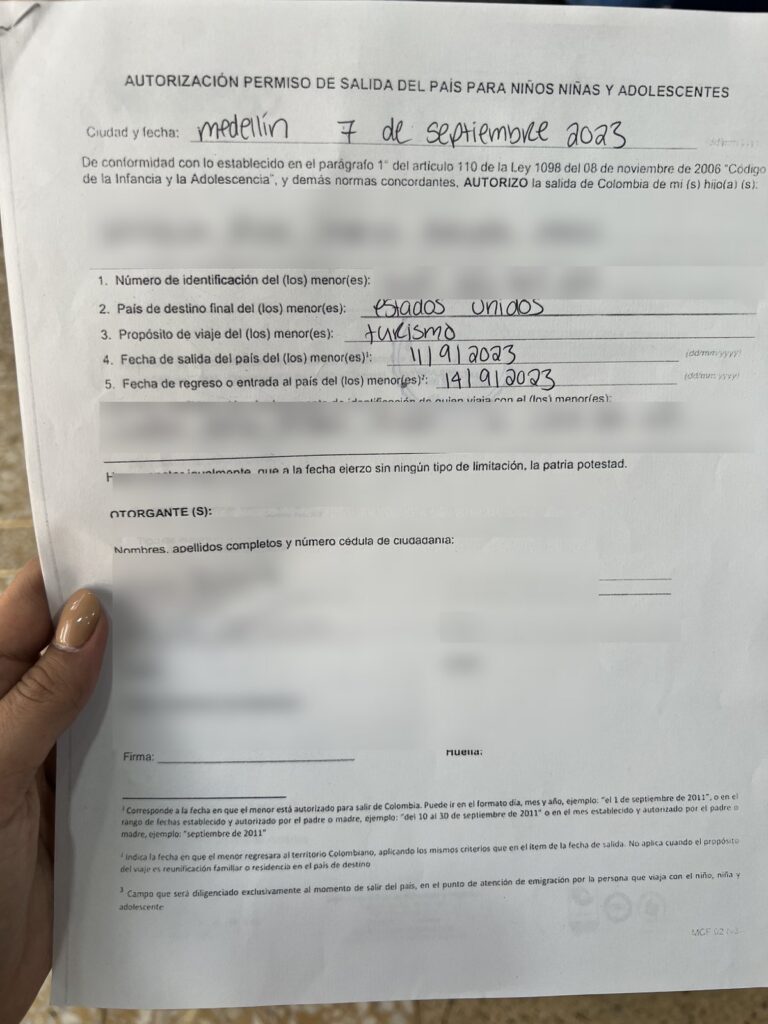
What the permission has to include: The destination, purpose, departure and return dates, and the accompanying person’s details. In Colombia, authenticate it before a notary. If a parent is abroad, you have two routes:
- At a Colombian consulate: Cancillería’s exit permit checklist specifically requires a valid passport from a foreign parent, plus a copy of the child’s birth record and the travel details. Follow the consulate’s appointment and signing instructions.
- Before a foreign notary: Where no nearby Colombian consulate is available, Migración describes a permission completed in Spanish, signed before a notary, apostilled and presented in original. If it’s on paper, arrange delivery of the original, because an emailed scan doesn’t replace it. If the document comes from a country outside the Apostille Convention, confirm the legalization route with the consulate and Migración before you arrange anything.
So use the official page’s forms and instructions for your situation. The overseas authentication section below explains where apostilles come from and how translations work.
Passport consent is a different document. The DS-3053 used for a U.S. passport doesn’t replace the Colombia exit permit for kids.
Do kids still need an exit permit if you have custody?
Custody (custodia) is different from parental authority (patria potestad).
- Custody alone: ICBF explains that custody alone doesn’t remove the other parent’s consent requirement.
- Suspended or removed patria potestad: Under Article 110, consent isn’t required from that parent. Bring the final, enforceable court decision. Don’t assume a foreign order is automatically recognized in Colombia.
- A child returning to a home abroad: A separate exception applies when a child has habitually lived abroad for at least one year and is returning to that residence with the custodial parent. Article 110 requires a consular residence certificate or consular registration, plus custody evidence. Cancillería’s certificate instructions specify custody issued or recognized by Colombian authorities. ICBF also lists an authentic copy of the birth record.
- The catch: Traveling with the other parent or another adult still requires the custodial parent’s permission and the applicable supporting documents. Living abroad by itself isn’t enough.
Can one Colombia exit permit cover repeated trips?
Yes. It’s the usual way to set up a Colombia exit permit for kids who travel a lot. A general or permanent authorization by escritura pública is a way to give consent for repeated travel. It’s not an exemption from consent. ICBF explains that you can request a constancia de vigencia from the issuing notary instead of making a new deed for every trip. It confirms the authorization is still in force. 10/10 would recommend.
Then check the paperwork before each departure. The sources don’t agree on how recent the validity note has to be:
- Migración’s main instructions give an initial three-month period, then require a validity certificate no more than one month old.
- Its detailed FAQ says 30 business days instead, and names the issuing notary or Colombian consulate as the source of the note.
- Because those windows differ, confirm the required recency and document format with the issuer and Migración before you rely on the deed.
How do you arrange the escritura?
- Start with a notary in Colombia or a Colombian consulate abroad. We went to where we registered our kids’ births to keep it easy and consistent. Ask specifically for a permiso permanente de salida de menor por escritura pública. Cancillería lists this as a consular service.
- Ask that office for its checklist, draft requirements and signing arrangements before you make the trip.
- Have the authorizing parent’s identity document, the child’s Colombian registro civil and the intended companion’s identification ready.
- Some offices want you to send a minuta (draft text) for review before they assign a signing appointment. Berna’s official instructions show that process.
- Follow your office’s requirements for originals, copies and how recently documents must have been issued.
- Check that the final wording covers the intended travel and companions. Then get the deed copy and the validity evidence you’ll need at departure.
What it was like when we did ours
Here’s how it went at our notaría. Processes change, and different notarías may tell you different things, so treat this as one family’s experience.
- What to ask for: Our notaría called it an autorización para salir del país. You may also hear poder para salir del país. It stays in force until a parent revokes it or the child turns 18.
- Who goes: Both parents, with valid IDs that haven’t expired. We didn’t need to bring the kids.
- What to bring: A copy of each child’s registro civil de nacimiento issued within the last 30 days.
- Spanish: You review and sign the escritura yourselves and confirm every detail is right. One parent who reads Spanish was enough for us. You only need a translator if neither parent does.
- What they asked: Address, email and phone number, plus each parent’s occupation.
- Time: About an hour and a half, start to finish.
Don’t skip the nota de vigencia
Here’s the part people miss: you still need the nota de vigencia before each trip. It’s the stamp confirming the escritura is still current and that the other parent hasn’t revoked it. Our notary recommended getting it within a week of travel. That’s stricter than the windows on Migración’s pages, so I’d go with the stricter one.
The upside is that either parent can pick up the nota de vigencia, so the traveling parent can handle it alone. With a one-time permission, the parent who isn’t traveling has to go sign every time. Plus, your details are already on file, so there’s no new paperwork for each flight.
We were also told notarized copies of the registro civil aren’t required at departure, but they’re handy to carry in case someone asks. One gap: I asked about kids who aren’t Colombian and live here on different visas, and our notary couldn’t say. If that’s your family, ask your notaría directly.
What does a permanent Colombia exit permit cost?
- In Colombia: The SNR’s 2026 tariff notice lists COP 90,600 for acts without a monetary value, before IVA, notarial paper and copies. That’s a tariff reference, not a confirmed total for your permission. Ask the notary to confirm the charge and give you an itemized amount, including any separate copy or vigencia costs.
- What we paid: About COP 200,000 for the escritura, plus about COP 9,800 per notarized registro civil copy. Your notaría’s total may differ.
- At a Colombian consulate: Fees follow a different schedule. For the U.S. and other locations in the “rest of the world” category, Resolution 03969 of 2026, Articles 6–7, lists USD 184 for protocolization, USD 18 for a copy and USD 34 for a certification. Those are separate fee components, not an all-inclusive quote. Confirm additional notarial charges, payment method and any local-currency conversion with your consulate. Euro-zone and Cuba rates differ.
- Later: Budget for later validity certificates too.
Can permanent permission be revoked?
Yes. ICBF says an indefinite permission can be revoked by escritura pública at the same notary. Ask that office for the revocation requirements and fees. If a consulate issued the original, contact it for its procedure. “Permanent” doesn’t mean irrevocable.
Also follow up on the notification separately. The official pages I reviewed don’t establish an automatic notary-to-Migración notification process. So:
- Ask the issuing office what it has recorded or communicated.
- Ask Migración what it needs to record your request.
- Then keep the revocation document and any filing references handy.
These are practical steps. The sources don’t give a universal notification deadline and don’t guarantee an immediate migration alert.
How do you request an impedimento de salida?
For a parent-requested restriction on a Colombian child or a foreign child resident in Colombia, Migración’s filing FAQ and ICBF’s guidance describe these steps:
- Prepare a signed letter. Explain the reasons for the request and include your contact and location details.
- Attach the supporting identity documents. Include the child’s registro civil and both sides of the requesting parent’s Colombian cédula, or the parent’s identification document if foreign. If you’ve revoked an escritura, ask Migración how to submit that supporting document too.
- File with Migración. The listed routes are a Centro Facilitador de Servicios Migratorios, a migration control post with extranjería functions, or the online PQRS channel. Use the official Centro de Consulta Ciudadana for online filing.
- Keep the radicado and follow up. Migración’s PQRSDF instructions explain the receipt and “Mis Casos” tracking. Ask for confirmation of the action taken, because a submission receipt alone doesn’t confirm a restriction is active.
What if the situation is urgent?
- A child may be taken out of Colombia imminently: Contact Migración directly through a Centro Facilitador or migration control post. Explain the urgency and have the signed request and supporting documents ready. Migración’s published Directiva 11 of 2012, section 6.3, instructs urgent handling and immediate database entry for parental or administrative restrictions received at those offices. It’s an older instruction about recording a restriction. It doesn’t establish an instant online service or a deadline for lifting one. Confirm current handling with the office and ask for confirmation of the action taken.
- The child needs immediate protection: ICBF’s free national Línea 141 operates 24 hours a day for protection, emergencies and guidance in Colombia. Calling it is a protection step, so keep going with the required Migración filing and follow-up.
- The child needs urgent medical travel abroad: ICBF lists this among the situations in which the Defensor de Familia can grant the permission directly (de plano). Contact ICBF about that procedure and disclose any existing restriction. The published guidance doesn’t say a medical need automatically clears an impedimento.
How can an impedimento de salida be lifted?
First, figure out who requested or ordered it. The route depends on the type:
- A parent’s personal restriction: Migración’s FAQ says the parent who requested it can lift it. The document guidance below applies to that parent’s lifting request. The FAQ also says a later valid permission from that same parent takes precedence over their earlier impedimento when the other exit requirements are met. A later registered impedimento takes precedence over an earlier permission.
- A judicial restriction: Get the appropriate decision from the competent judicial authority. Migración directs questions about judicial impedimentos and precautionary measures to the Policía Nacional, which communicates the official record to Migración. Migración can’t independently change or certify that judicial information.
- An administrative child-protection measure: Contact the authority responsible for the case. Article 103 of the Childhood Code lets the competent administrative authority modify protection measures when the circumstances that led to them have demonstrably changed. A parent’s new permission doesn’t replace that decision.
What documents support a parent’s lifting request?
A November 2024 Medellín court decision (paragraph 44) reproduces the parent-request checklist from a 2019 interagency agreement:
- Your child’s full name and identification, an explicit request to lift the impedimento, and your telephone number and address
- The requesting parent’s cédula and the child’s registro civil, to establish parentage
- In Colombia: Present the request personally before Migración Colombia or have it authenticated by a notary.
- Abroad: Present it personally before a Colombian consulate, or use a local notary with the apostille or legalization that applies.
This is a documented checklist for a parent’s request. It’s not a universal bundle for judicial or child-protection measures. Confirm the current submission route and accepted document formats with Migración. The checklist predates this guide’s review, and it doesn’t establish a document-expiry period or require a newly issued registro civil.
If you’re a foreign parent: Migración’s initial impedimento-filing FAQ accepts the foreign parent’s identification document but doesn’t say which types. The dated lifting checklist says “cédula” without explaining the foreign-parent alternative. Ask Migración which ID and copy format it accepts for your lifting request. The valid-passport rule for signing an exit permit at a consulate is specific to that service. It doesn’t mean a passport or cédula de extranjería is automatically enough for every lifting request.
How long does lifting a restriction take?
Official sources I reviewed don’t give a guaranteed time for removing the restriction from the record or clearing travel.
- The general rule: Colombia’s petition-response period is 15 business days, unless a special legal period applies.
- The exceptions: Law 1755 of 2015 (Articles 14, 17 and 21) sets different periods for some request types, plus rules for incomplete requests, transfers to the competent authority and exceptional extensions.
- What that means: A response deadline isn’t a promise that your request will be approved or the record cleared within that period.
So keep your filing reference and your supporting permission or authority decision. Ask which deadline applies and what has been communicated and recorded. Confirm the outcome before you rely on it for travel. A filing receipt or an upcoming flight alone doesn’t establish clearance.
How do overseas authentication and translation work?
If you use the Colombian-consulate route, follow that office’s signing and document-delivery instructions. But if the Colombia exit permit for your kids was signed before a foreign notary, check the country of origin first.
Apostille route: The competent authority in the country that issued the document supplies the apostille when the Hague Apostille Convention applies. Colombian Cancillería doesn’t issue that foreign apostille. Its Circular 112 of 2021 confirms a properly apostilled foreign document doesn’t also need certification or legalization by Colombian Cancillería. Any required translation and the receiving office’s substantive requirements still apply.
Legalization route: For foreign documents from countries outside that Convention, Resolution 1959 of 2020, Article 9, sets out this sequence:
- Complete legalization with the competent authority in the document’s country of origin, following that country’s requirements.
- Take the legalized document to the Colombian consulate accredited there to authenticate the legalizing authority’s signature.
- Complete Colombian legalization online through Cancillería, unless the consulate already arranged that step with the previous service. Ask what was completed before you make a duplicate request.
If Colombia has no office in that country, ask the Colombian consulate with jurisdiction for the applicable route. Articles 10–11 also provide for a país amigo chain through a third country or the consulate responsible for the territory. An ordinary notary stamp alone doesn’t complete these chains.
What counts as an official Spanish translation?
- Who can translate: For a translation prepared in Colombia, use a traductor oficial. Article 33 of Law 962 of 2005 says the document issued by an authorized university confirming the person passed the official translator/interpreter exam is their license to practice. Licences issued before that law took effect also remain valid.
- Checking a translator: Ask for the translator’s qualification document and check it with the issuing institution if needed. Universidad de Antioquia’s verification page lists the name, examination record number and year for translators it certified. Not being on that university’s list doesn’t by itself invalidate a different institution’s qualification or an older license.
- What Cancillería does and doesn’t do: Cancillería doesn’t maintain an official translator list or certify competence. Its circular says the translator must demonstrate accreditation when the receiving national authority requires it. That’s not a blanket instruction to attach a credential copy to every submission.
For documents you’ll use in Colombia, Cancillería’s “Traducciones Oficiales” instructions include:
- Official translation prepared in Colombia: The translation itself doesn’t need apostille or legalization for use in Colombia.
- Translation issued abroad: It must be apostilled or legalized in its country of origin for use in Colombia.
The source document still needs any authentication required for it, and Cancillería recommends authenticating it before translation. None of this means every supporting document must be translated, so confirm the language and format required for your particular filing. Migración’s foreign-notary exit permit instructions above specifically call for the permission in Spanish and in original.
Which document format should you request?
It depends on the document and how it was issued:
- Verifiable Colombian consular permission: Berlin’s official consular instructions explain that the issued permission can be sent electronically to the person in Colombia, who prints it to present to Migración at departure. Frankfurt’s instructions say to give the consulate-issued Código de Verificación at departure so Migración can check the permission in its systems. Keep a complete, readable printout and the verification code together. New Delhi’s consular guidance also links to Cancillería’s document-verification portal for checking consular notarized documents. That lookup doesn’t replace the printed permission or Migración’s departure checks. Follow your issuing consulate’s instructions.
- Paper permission signed before a foreign notary: Migración’s instructions require the Spanish-language, apostilled permission in original. Arrange delivery of that original, because a scan of a paper original isn’t the same document.
- Birth record used as supporting evidence at departure: Migración’s child-travel FAQ accepts a legible original, copy, photocopy or digital birth record. That doesn’t replace the child’s passport, and it doesn’t extend digital acceptance to every other supporting document.
- Colombian apostille or legalization certificate: Resolution 1959, Article 13, provides for electronic verification online or by QR code together with the source document. Keep the issued electronic file and verification details. Electronic authentication doesn’t by itself remove a separate requirement to present the source document in original.
Missing codes, corrections and reissue fees
- Verification code problems: Cancillería’s document lookup needs the verification code and issue date. Check both against your permission. If details are missing, unreadable or wrong, or retrieval fails, ask the issuing consulate to check the record and explain the next step. Have the document and error message ready. CIAC can give further orientation.
- Correction or replacement: Cancillería’s July 2024 consular staff guide (pages 22–26) provides for replacement of an already authorized application without another application payment when a processing error wasn’t the citizen’s responsibility. Ask the consulate whether that applies. It doesn’t make every requested change free.
- If a new paid permission is needed: The 2026 tariff, Article 9, lists USD 13 outside the euro zone/Cuba and EUR 9 in those locations. Miami’s 2026 instructions specify USD 13 per authorizing signature. Confirm the charge, exemption, local currency and payment method with your consulate. This is separate from the escritura pública fees above.
- Use the final authorized version: The staff guide says a consular system reprint creates a new verification code that replaces the old one. That’s different from printing another copy of the same issued PDF. Ask for the latest authorized document and code, because a version marked Borrador is still a draft. The guide doesn’t promise a correction turnaround time, and a support request doesn’t replace the permission or establish departure clearance.
For a translation or a lifting-request document, confirm the receiving office’s accepted delivery format and whether it needs the translator’s accreditation attached. The sources I reviewed don’t establish universal email-only acceptance or one translation layout for every case.
How do you upload documents to Cancillería?
For an apostille or legalization, the upload rules are strict:
- Resolution 1959, Article 7, requires a clear, legible, complete PDF, no more than 11 MB, without alterations or unrelated extra documents.
- Circular 112 adds that documents in a legalization chain should be scanned completely, including the consular label. Its partial-scanning exception doesn’t cover child exit permits.
- Additional material belongs in the same PDF only when the source document identifies it as an annex or translation.
Those are requirements for that authentication process. They don’t set the upload limit for Migración’s PQRS service, and they don’t replace the original travel document required for the foreign-notary permission route.
What changes if the other parent is registered in REDAM?
- The exception: Law 2097, Article 6(6) removes the consent requirement for the parent registered in REDAM, Colombia’s register of delinquent support debtors. Missed support payments alone aren’t the same as formal registration. The exception covers that parent’s consent only. The child still needs the other applicable travel documents.
- What to bring: A current certificate showing that parent’s REDAM registration, which migration control keeps. Migración’s main instructions request the original, and its detailed FAQ also accepts legible copies. Confirm the format beforehand and check the validity shown on the certificate. The FAQ says an expired certificate must be replaced, or the parent’s permission obtained.
- If you disagree about consent and no exemption applies: ICBF directs families to a family judge.
- Whereabouts unknown, parent unable to consent, or no legal representative: A permission procedure through ICBF’s Defensor de Familia may be needed. These aren’t automatic waivers.
- Deceased parent, single-parent birth record or other special situations: Use the case-specific Migración FAQs.
- Also check: Your airline’s and any transit country’s requirements, since the Colombia exit permit only covers kids leaving Colombia. Then use my checked-bag list for traveling with kids for the rest of the prep.
Colombia exit permit for kids: FAQ
Do kids need an exit permit to leave Colombia with one parent?
Yes, as long as they carry a Colombia exit permit from the parent who isn’t traveling. That permission has to be authenticated, unless one of the exceptions above applies.
Do dual-citizen kids on a U.S. passport need a Colombia exit permit?
Yes. If your kids have Colombian nationality, the Colombia exit permit rules apply even when they travel on a U.S. passport. Also, the DS-3053 passport consent form doesn’t count.
How long is a Colombia exit permit (permiso de salida) valid?
A one-time permission covers the trip and dates written in it. A permanent one by escritura pública stays in force until a parent revokes it or the child turns 18. But Migración asks for a recent validity certificate before each trip, and its own pages disagree on how recent, so confirm with the notary and Migración.
Can I sign the exit permit for my kids before a U.S. notary?
Only as a fallback. Migración describes that route when no nearby Colombian consulate is available: the permission in Spanish, signed before the notary, apostilled, and the paper original delivered. Otherwise, sign it at a Colombian consulate.
Does custody mean I don’t need the other parent’s permission?
No. ICBF says custody alone doesn’t remove the other parent’s consent requirement. The main exceptions are a suspended or removed patria potestad, a child returning to a home abroad with the custodial parent, and REDAM registration.
Can the other parent stop a trip?
Yes. A parent can ask Migración to register an impedimento de salida. Lifting one depends on who requested it, so start with the impedimento section above.
Official links and resources
Colombia exit permit, travel and consular help
- Migración Colombia: children’s exit requirements and permission forms
- Cancillería: residence-abroad certificate and custodial-parent exception
- Migración Colombia: special-case travel FAQs
- ICBF: exit permits, custody and family-judge procedures
- ICBF: ongoing permission by escritura pública
- Article 110: parental authority and residence-abroad exceptions
- Law 2097, Article 6: REDAM consequences
- SNR: 2026 Colombian notarial tariff guidance
- Cancillería: 2026 consular deed, copy and certification rates
- ICBF: revoking permanent exit permit
- Migración Colombia: official PQRS filing and consultation channel
- Migración Colombia: PQRSDF filing receipts and follow-up instructions
- Migración: published 2012 instruction on urgent recording of minor exit restrictions
- ICBF: protection guidance and 24-hour Línea 141
- Tribunal Superior de Medellín: 2024 decision quoting the parent lifting checklist (paragraph 44)
- Law 1755 of 2015: petition-response deadlines and procedure
- Constitutional Court T-469/25: general petition-response period in business days
- Cancillería: consular exit permit signing and foreign-parent passport
- Colombian consulate in Berlin: electronically delivered permission printed for travel
- Frankfurt consular instructions: verification code presented at departure
- New Delhi consular instructions: official document-verification portal (page 3)
- Cancillería: CIAC citizen-support channels
- Cancillería staff guide: permission corrections, replacement and verification codes (July 2024)
- Miami consulate: 2026 exit permit fee per signature
- State Department: dual nationality and U.S. passport use
Apostilles, legalization and translations
- Cancillería: apostilles for foreign documents
- Cancillería: legalization of foreign documents
- Cancillería: official translations for use in Colombia
- Resolution 1959 of 2020: foreign-document legalization chains (Articles 9–11)
- Circular 112 of 2021: apostilled documents and official translators
- Law 962 of 2005, Article 33: translator qualifications and existing licenses
- Universidad de Antioquia: verification of translators it certified




Leave a Reply