This post may contain affiliate links. Read my full disclosure here.
Two things are guaranteed in El Hueco Medellín: you can almost find anything there and go with a plan or you will get lost. I’ve been shopping here for a couple of years now. School supplies in July, kids soccer kits, last-minute birthday gifts, christmas gifts & stocking stuffers. And there are so many passageways I’ve never walked.
This is not a mall. This is a living, breathing commerce in the heart of downtown Medellín, built by families from the pueblos of Antioquia, one storefront at a time. If you’re new to the city, planning a visit, or one of the families navigating Colombia who keeps hearing the name and not understanding what it actually is, this guide is for you.
I recently did a guided tour with a wonderful local guide named Valeria, and it cracked the place wide open for me in a way years of solo trips hadn’t. I’ll get to her in a minute. First, here’s what you’re walking into.
In this guide
- What Is El Hueco Medellín?
- A Quick History: Why El Hueco Exists Where It Exists
- La Candelaria: The Bigger Picture
- Carabobo: The Front Door
- Understanding the Locales (Store Numbers)
- Practical Tips for Shopping El Hueco (From a Mom Who Does This Regularly)
- My Tour With Valeria & ValenTours
- Visiting El Hueco FAQ
What Is El Hueco Medellín?
El Hueco is one of Medellín’s busiest commercial districts, and it is big. Comfenalco’s local directory describes the wider shopping area with these figures, and they sound made up when you say them out loud:
- More than 5,100 shops
- 84 commercial centers (centros comerciales)
- 66 passageways
That’s a description of the whole district, not a fresh shop count, and it’s not one shopping center. Think ballpark.
The wider area stretches through Guayaquil and the downtown sectors around it, roughly between Calle Colombia, Calle San Juan, Carrera Bolívar, and Avenida del Ferrocarril. People talk about “going to El Hueco” the way New Yorkers say “going downtown.” It’s a whole world, not a single address.
Not a Mall. It’s A Maze
If you walk in expecting a Colombian version of a North American shopping mall, you will be confused within ten seconds. El Hueco is the opposite of curated. Storefronts open into other storefronts. A jewelry shop bleeds into a perfume shop bleeds into a passage of school uniforms bleeds into a corridor of nothing but housewares. Some centers do have directories, like El Hueco Número Uno’s online shop search, but that doesn’t make the whole district easy to navigate. The signage is mostly for people who already know where they’re going. What actually helps is a shop name and a local number.
That’s the point. That’s the charm.
Why It’s Called “The Hole”
El hueco literally means “the hole.” You’ll hear a few stories about where the nickname came from, and I haven’t found one documented origin. But as a description of the shopping experience? It makes perfect sense.
You fall in. And you don’t come out.
You know the Target effect? You walk in for detergent and walk out with a cart full of things you didn’t know you needed and can’t explain. El Hueco invented that. Except here it’s a soccer kit, two pairs of leggings, a set of plastic containers, and a bag of empanadas you already finished while browsing more things you didn’t need.
The hole pulls you in. That’s just what it does.
The name gets used for the whole shopping district and also in the names of individual centros comerciales. So when someone sends you to “El Hueco,” ask which one. The name alone won’t get you to the right shop.
A Quick History: Why El Hueco Exists Where It Exists
People have been doing business on this corner of Medellín for a very long time. The city’s history of the center dates the covered Guayaquil market to around 1894, well before the train showed up.
The Train Station That Built a District
The old Medellín station of the Ferrocarril de Antioquia helped anchor all that. A city history publication dates its inauguration to March 9, 1914. Guayaquil was already a market neighborhood, and the railway tied it more tightly to the rest of Antioquia.
The railway brought goods and people into Guayaquil and helped turn it into a transport and trading hub. Coffee was stored in the railway’s warehouses before heading toward export markets. The shopping district you walk through today grew out of that much older commercial life, long before the modern malls of El Poblado existed.
The Pueblo Connections Behind El Hueco
The merchants’ connections to the pueblos go back much further than the late 1990s. EAFIT’s account of research into El Hueco describes migrants from eastern Antioquia building businesses here in the 1970s, leaning on family ties, trust and shared resources. Asoguayaquil, the merchants’ association, came later, in 1997. That date is when the association started, not when the migration did.
One passage at a time. One family at a time.
That’s part of why the labyrinth feels the way it does. It wasn’t designed. It was grown, through people and their connections, over decades.
La Candelaria: The Bigger Picture
El Hueco sits in downtown La Candelaria, Comuna 10, alongside Parque Berrío, Plaza Botero, the Palacio de la Cultura, the old train station and San Antonio Park. This is the historic center of the villa established in 1675.
The city’s official history also traces an earlier colonial settlement to San Lorenzo de Aburrá in 1616, in today’s El Poblado, and recognizes the Indigenous communities who lived in the valley before that.
Quick note if you’re coming from Bogotá or have spent time there: yes, there’s a La Candelaria there too. Same name, completely different energy. Bogotá’s is cobblestone streets and colonial architecture. Medellín’s is vendors calling out prices and carts stacked with goods. Don’t let a search result send you to Bogotá when you’re planning a morning in Medellín.
When people say they’re going to “el centro,” they usually mean somewhere in La Candelaria. El Hueco is the working, sweating, bargaining commercial engine of that historic core. You can spend a whole morning in El Hueco and a whole afternoon walking Plaza Botero and the cathedrals without ever leaving Comuna 10.
Carabobo: The Front Door
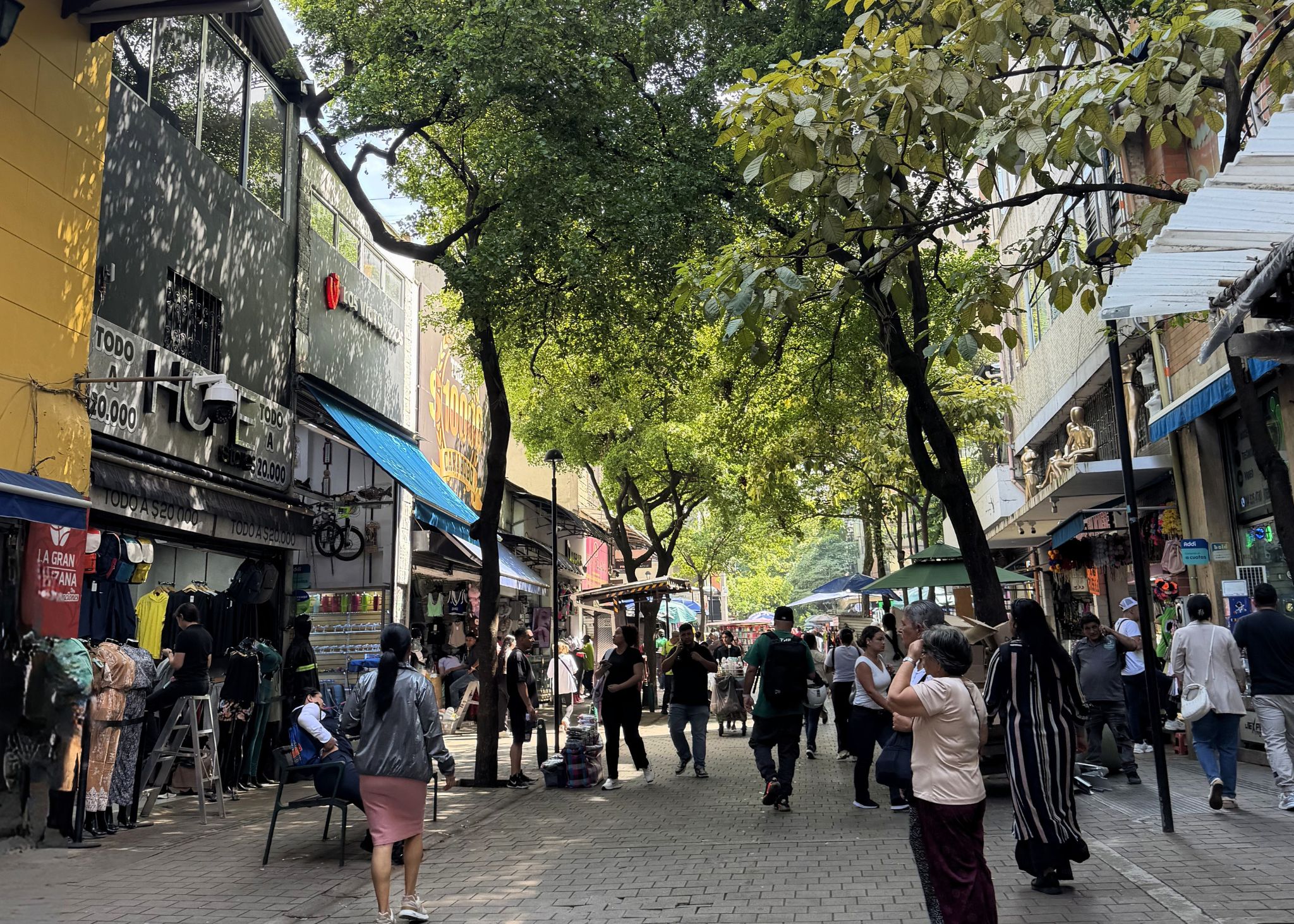
Carrera Carabobo (Carrera 52) is a busy pedestrian shopping street in downtown Medellín. The pedestrian stretch roughly runs from Parque de las Luces up toward Plaza Botero, lined with shoe shops, snack bars, and street vendors with megaphones shouting prices.
For most visitors, Carabobo is the front door into El Hueco. You hop off the metro at San Antonio, walk west, and the energy thickens around you the closer you get. By the time you cross into the alleys off Calle 46 or Calle 48, you’re in.
Understanding the Locales (Store Numbers)
Here’s a small but important thing to know before you go in: lots of shops are identified by a local number. Something like Local 121A, Local 366, Local 602. When a vendor or a regular tells you where to find something, they don’t say “the shop with the pink awning next to the empanada lady.” (Well, they might. But that won’t actually help you.) You’ll hear something like this:
“Centro Comercial Hueco Pichincha, local 121A.”
The centro comercial name plus the local number gets you a much better starting point, and once you start reading the numbers, the chaos has a system. If a friend recommends a specific shop, get these before you go:
- The centro comercial name and local number.
- The street address or entrance.
- The floor, if there is one.
- A location pin.
Practical Tips for Shopping El Hueco (From a Mom Who Does This Regularly)
Things you’ll be glad to know from day one.
Bring Cash. Really.
Bring some cash in a mix of bills. Don’t assume every shop is cash-only, though. Some take cards, bank transfers, Nequi or Daviplata, and some don’t. The city’s visitor guide recommends cash because cards aren’t accepted everywhere, which is why I say bring it. Exact change is handy, but it doesn’t guarantee a discount.
Todo está. You Can Find Anything.
Anything you need is here. School supplies, uniforms, soccer cleats, the whole Selección Colombia kit, baby clothes, fabric, piñatas, birthday gifts, kitchen supplies, perfume, jewelry, suitcases, leather, holiday decor, costumes, beauty products stacked literally floor to ceiling. If you can name it, El Hueco sells it. Usually three doors apart, at three different prices.
Touch Before You Buy. Watch for Segundas.
Quality varies wildly. Some shops carry brand-new, well-made products. Others sell segundas or seconds, factory rejects, items with minor flaws. Both have a place, but you need to know which you’re holding. Check the seams. Check the zippers. Try the soccer cleats on the kid. Smell the perfume. Read the tags. The people who shop here every week do this without thinking.
Ask About the Price. Then Compare.
Some vendors will negotiate, especially if you’re buying several things. Others have fixed prices. Know what you want, compare a few shops, and be ready to counter-offer or walk away. Walking away works more often than you’d think. More than once I’ve taken three steps and heard a vendor call out a much better number. Don’t assume a high quote is about your accent, either. Compare first.
Timing Is Everything
- My pick: weekday mornings, between 9 and 11 a.m. In my experience, crowds are thinner. Check the shop’s opening time first.
- Watch for quincena. Mid-month and month-end paydays can bring more shoppers. Not everyone gets paid on the same dates, but when downtown floods, it’s pura locura.
- December gets busy. From late November through Christmas, expect holiday crowds. Beautiful chaos, but not my pick for introducing a five-year-old to crowd navigation.
- Plan a daytime visit. The official visitor guide suggests roughly 9 a.m. to 3 p.m. Hours vary by shop and passage, and some centers do open on Sundays.
Dress Down. Backpack in Front. No Jewelry.
This is the same advice I’d give for any busy commercial district anywhere in the world. Wear something casual. Keep flashy jewelry at home. Backpack on your front in crowded passageways. Phone in your bag, not your hand. A simple crossbody works great. Keep your stuff close and move with intention. Blending in is a good goal, but nobody is immune to theft, locals included.
Bringing the Kids
You’ll see kids in El Hueco — strollers, school-age kids in tow, the whole thing. It’s a family place. But let me be real with you: I don’t even love shopping with my kids at a regular mall, so I usually leave them at home and give myself the freedom to browse and take my time.
That said, I’ve brought my oldest before to shop for school supplies and it was completely fine — because I knew exactly where we were going and what we needed. That’s really the key. When you have a plan, know the timing, and feel comfortable in the space, kids are totally manageable here. Like anywhere.
But if it’s your first time and you actually want to enjoy the experience? Leave them home. Reconnaisance mission first. Kids later.
Know Your Prices
Before you go, look up what something comparable costs at a regular mall (Mayorca, Premium Plaza, Santafé). Now you have a reference. Compare the actual item, though: the quality and what the seller includes, because something that looks the same may not be. If a quote doesn’t work for you, smile, say gracias, and walk to the next shop. A mall-level price doesn’t automatically mean you’re getting tourist-taxed.
Safety: Common Sense, Not Fear
I want to be real clear about this part because the internet loves to scare people. El Hueco is a working commercial district with families pushing strollers, abuelas with shopping carts and dads buying their kids cleats. That’s the place I know from shopping here. It’s also a place where you need to pay attention and have a plan you’re comfortable with.
Theft can happen here, pickpocketing included. Go in aware.
- No dar papaya. Colombian shorthand for not making yourself an easy target. Stay aware, keep valuables out of sight, and stick to streets with commercial activity during daylight.
- Precautions help, but they’re not a guarantee. They lower your odds. They don’t zero them.
- It’s never the victim’s fault. If someone robs you, that’s on them.
A Quick Note on Language
This isn’t built for tourists. It’s a working market for working Colombians, and Spanish is the language of the place.
That’s not a barrier. That’s a sign of respect to the place.
If your Spanish is shaky, that is genuinely fine. Try anyway. In my experience, vendors are patient. Numbers are universal, calculators come out, smiles get you very far. What doesn’t fly is showing up with the energy of someone who expects English, sighing when nobody speaks it, and treating Spanish like a problem instead of the actual language of where you live or are visiting.
Learning to navigate El Hueco in Spanish, even badly, is one of the most respectful things you can do here. There is no place for entitlement in a maze built by people from the pueblos.
My Tour With Valeria & ValenTours
I want to talk about Valeria for a minute, because she changed how I see this place.
When I went, she was starting monthly themed tours of El Hueco. I went on the first one, a Mother’s Day theme focused on beauty products, t-shirts and perfumes. She also offered custom tours for a specific shopping list, so ask her what she’s doing now.
I lucked out! My tour ended up turning into a hybrid since it was just me: I was down for the ride but also let her know I was looking for new Selección Colombia kits for my kids, a couple of birthday gifts, and made the most of refilling my beauty cabinet without the markup.
Walking through El Hueco with Valeria was like going to a party where you finally know someone who knows everyone. She knew every entrance. Every shortcut. Which passageway connects Hueco Pichincha to Megacentro without going back outside. Which beauty shop stacks product floor to ceiling. A busy shop doesn’t always mean fresh stock, though, so check seals, labels and expiry dates.
She and her sister also did the thing I cannot do, which is negotiate across vendors at a paisa-level. They asked three shops the price of the same item in three minutes flat, and we’d circle back to the best one with the right answer in hand. I saved real money. More importantly, I now actually know where to go when I need things, instead of wandering into the maze and hoping.
If you’re new to Medellín or new to El Hueco, I’d look into a tour with ValenTours. It’s not about needing a babysitter, it’s about getting handed a key to a city you live in. Check her Instagram for her current tours, pricing and the best way to reach her. The WhatsApp number I had for her was +57 300 2600379, but confirm it on her current profile before you use it.
Visiting El Hueco Medellín FAQ
Location: Guayaquil and the neighboring downtown sectors of La Candelaria (Comuna 10). The wider commercial area runs roughly between Calle Colombia, Calle San Juan, Carrera Bolívar, and Avenida del Ferrocarril. Get the address of the particular shop you’re headed to.
Hours: There’s no one schedule for the whole district. El Hueco Número Uno lists Monday–Saturday 8 a.m.–7 p.m. and Sundays/holidays 9 a.m.–5 p.m. (checked October 25, 2026). Those are that center’s published hours, not a promise that every shop is open. I’d still go in the morning.
How to get there: The Metro lists San Antonio on Lines A, B and T (the Tranvía), and Cisneros on Line B as nearby stations. From San Antonio, head west toward the shopping streets. How long the walk takes depends on your exit and the shop, so save its street address and local number first.
Cost: There’s no admission ticket for the district. You only pay for what you buy. Budget for your purchases and transport, plus a guided tour or any other paid service if you decide to book one.
Pro tip: Go on a weekday between 9 and 11 a.m., bring cash in mixed bills, wear a small backpack on your front, and have a list. If it’s your first time, look into a guided tour with ValenTours and let someone who knows the maze do the navigating while you focus on the shopping. Ask what she’s offering now.
My Tour With Valeria & ValenTours
It would be easy to write El Hueco off as “the cheap shopping place.” A lot of guides do. But the longer I live in Medellín, the more I see this district as something else entirely.
This is generational commerce. Family and hometown connections are woven through the whole place, and you can see why relationships matter as much as the passageways. Every shop has its own story, and I’m not going to pretend I know the family history of each one I walk into.
When you spend money here, you’re not feeding a logo. You’re supporting the people doing the everyday work of keeping these businesses going, one storefront at a time. That’s worth doing on purpose.
It’s also where I do my real shopping as a mom living here. School supplies in January? El Hueco. Bici cross gear for my son? El Hueco. White boots for my daughter’s K-Pop Demon Hunters costume? El Hueco. The piñata, the party favors, and the gift bags for whichever kid is turning whichever age this month, and there’s always one, El Hueco. The everyday stuff that makes a family run. You figure that out pretty quickly when you live here.
It’s not a museum. It’s not a “must-see attraction.” It’s a place where the city actually works.
If this guide helped you feel less intimidated about El Hueco, save it, screenshot it, send it to the friend who’s moving to Medellín next month and excited about exploring about the city center.
For more guides like this from someone living, parenting, and figuring it out in Medellín alongside you, follow along on Instagram at @mamainmedellin. I share the small stuff there too: the playgrounds, where to find extracurriculars for your kids, the days that go sideways and the days that don’t.
Leave a Reply